


The weekly 128
The shepherds...
They are present as soon as men stop being nomads to become farmers and breeders.
- Thus Oetzi, whose mummified body was discovered in an alpine glacier (1991). More than 5,000 years B.C.E., historians call it a shepherd, accompanying the herds of the valley to the mountainous pastures.
- In mythology, here is Eurytion, a shepherd occis by Hercules during the tenth of his « Twelve Works ».
- And in the Bible, warned and guided by angels, they were the first to arrive at the place where Jesus was born; They also feature prominently in all Christmas crèches.
At all times (Gaulian, Roman, medieval), shepherds and sheep appear on bas-reliefs, mosaics, stained glass windows... later in literature and music where the shepherds appear! We all know this song learned from childhood and popular during the French Revolution:
♫♪♪♫♪♫
It rains, it rains
Bring in your white sheep
Let's go under my cottage.
Bergère, come on.
I hear under the foliage
Water falling at high noise.
Behold, come in the storm,
This is the lightning that shines.
♪♪♫♪♪♫♪
He said that behind these charming words due to Fabre d'Eglantine, he announced 1789: the shepherdess, Marie-Antoinette and the storm approached, it was the people who roared and would soon revolt.
But let's go back to our sheep or rather to our shepherds!
If they are hardly present at Pagnol*Daudet staged them in several of his « Letters » and Giono made it the main character of « The man who planted trees » :
It was a beautiful day of June with great sun [...] He seemed to me to see a small black figure standing in the distance. I thought she was the trunk of a lonely tree. At any rate, I went towards her. He was a shepherd. About thirty sheep lying on the burning earth rested near him. [...] This man spoke little. It's the fact of the lonely...
Mistral wrote: And the last shepherd who will speak Provençal, if our language were to disappear in hundreds of years, would represent Provence much better than all the francisés, however talented they are.
– Where is our shepherd?
Patience... He's coming... There he is!
Jeanne Monin
*barely one « Gutter shepherd » in « The Baker's Woman » : the return of the Pomponnette pussy.
Manon of the springs is not a shepherdess: she keeps goats, like Paul, Marcel's little brother... yet Pagnol wrote « brother of shepherd »...
« The excuse for this translation, [« The Bucolics » – Virgil] […] is that she is the one of a shepherd's brother who helped the deer mother, who sowed the goat's hoof, who picked all the plants of Virgil and saw the golden moon rise through the branches of the oliviar ».
Research on various sites.
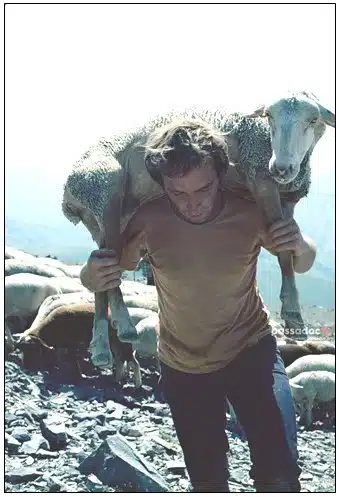
I just found this 40-year-old photo taken on the slopes of Mont Mounier, in Mercantour, in the commune of Beuil (Alpes-Maritimes). My friend Bernard Bellini de Châteauvieux (High Var) carries on his shoulders a wounded sheep.
During the 100 days they spend in the high mountains, shepherds are charged with sheep that do not belong to them all. In the absence of a nearby veterinarian, they must provide first aid to injured or sick animals... There are currently 35 hours of weekly work... shepherds during the summer do them in less than three days.
In taking the picture, I immediately thought of the images of the Good Shepherd bringing back the lost sheep, present on the religious paintings of the Middle Ages. He takes care of the lost sheep, but he must keep an eye on the rest of the flock. Not easy. The return of the wolf makes the work of the shepherds singularly complicated, I understand their distress.
Since the photograph was taken, the Mercantour National Park has been created on horseback on the Alpes-Maritimes and the Alpes de Haute Provence.
André Abbe
Maryse Laugier
Beautiful photo I keep preciously in my photo archives. It is the father of Nans Bellini, who was mayor of Châteauvieux...
Dali Gues
A time that I shared because my brother Jean-Pierre was also with him in transhumance. Thank you for the good memories.
Jean-Jacques Murat
had that ship voio de saupre
Other
E of soul
per sei from years old
e a pau pau pau pau pau pau pau pau pau pau pau pau pau pau pau pau pau nau pau pau pau pau pau pau pau pau pau pau pau pau pau pau pau pau pau pau pau pau pau pau pau pau pau pau pau pau pau pau pau pau nau pau pau pau pau pau pau pau pau pau pau pau pau pau pau pau pau pau pau pau pau pau pau pau pau pau pau pau pau pau pau pau pau pau pau pau pau pau pau pau pau pau pau pau pau pau pau pau pau pau pau pau pau pau pau pau pau nau pau pau pau pau pau pau pau pau pau pau pau pau pau pau pau pau pau pau pau
a vist leis estello au cèu
- The Echoes of the Week
Nissa the Bella...
Poudès mastega plan...
The Three Crosses
Kilometer stops
Fayence... 2 July - Participate in Passadoc!
Nissa la Bella
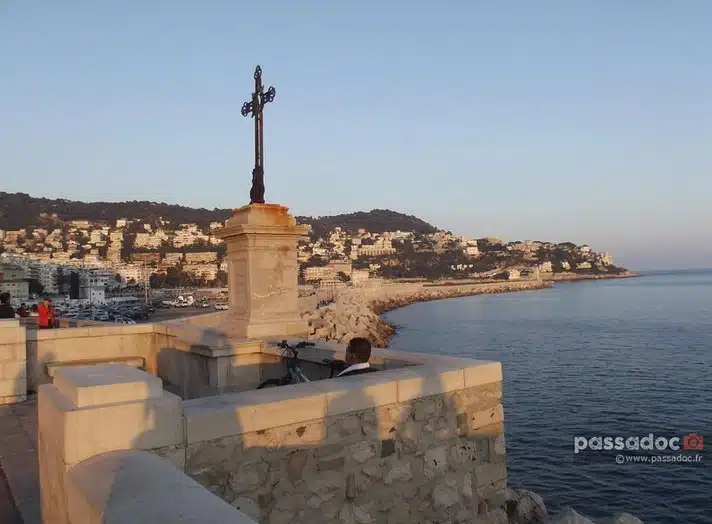
Poudès mastega plan...

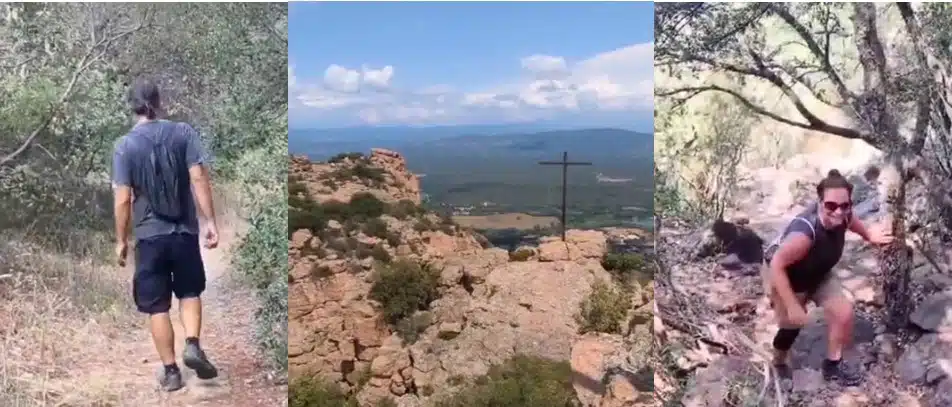
The Three Crosses
Walk with Italian friends Alex and Brian to the summit of Rocher de Roquebrune (Var).
They propose guided tours the village of Roquebrune-sur-Argens and the new photo exhibition on the art of living in Provence « Works and days ».
Kilometer stops
AG GA
My father was a prisoner there, like many. He still lives, but never talks about this period except for anecdotes like sleeping on pepper bags, hearing tigers at night or drinking champagne after several days without meals...
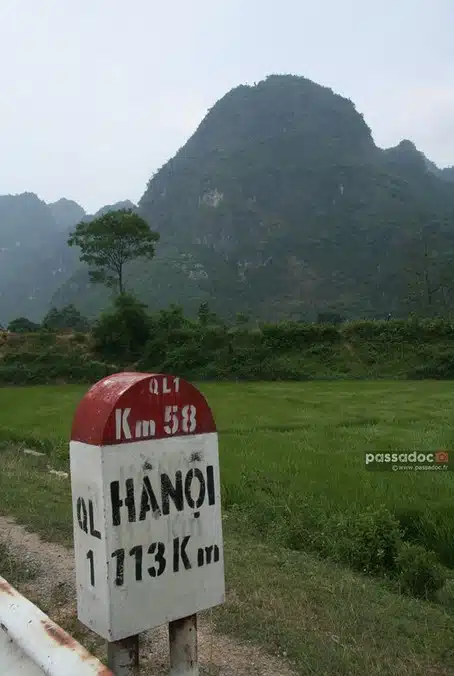
It is André Michelin who sows the terminals along our roads; they are yellow for the department and red for the national; all have a number, names of localities; which does good service to the travellers of the time and ends – or almost! – to such dialogues:
– Tell me... Here, how do we win Roquebrune?
– At the exit of the village, follow the stone path; with the big oak, turn right. From afar, you will see a white bastide... You've almost arrived...
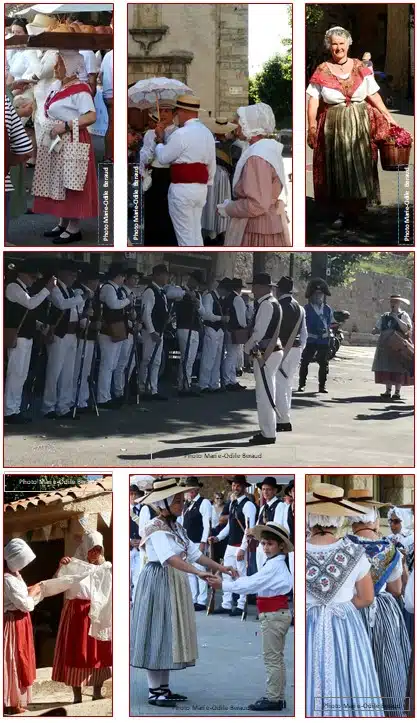
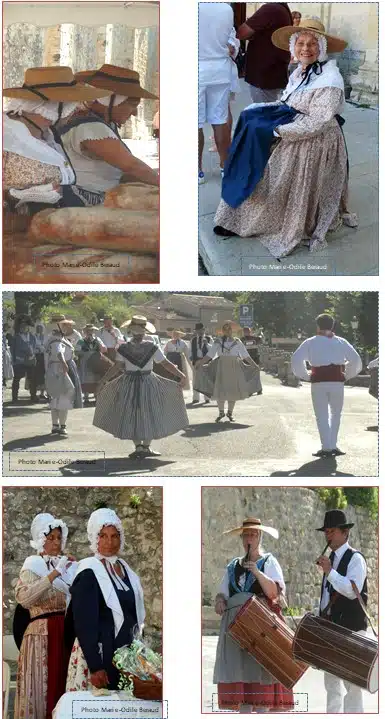
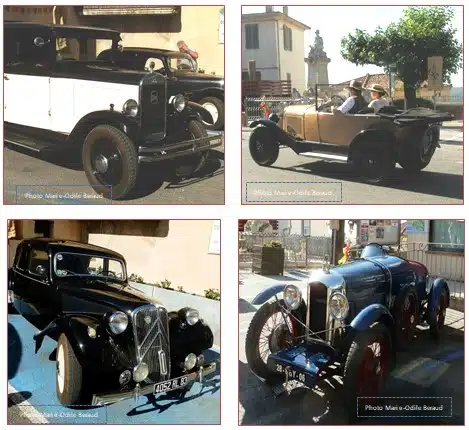
Fayence... as in 1900!
It was the eleventh edition of the Feast of Bread.
Provencal costumes... Fibers and tambourines... Old cars
Marie-Odile Beraud has provided images!



- Writing Passadoc – Participated
(texts and/or photos):
André Abbe
B. Barber and A. Rosa
Marie-Odile Beraud
AG GA
Dali Gues
Maryse Laugier
Jeanne Monin
Jean-Jacques Murat Layout
Jeanne Monin