


Hebdo No 198
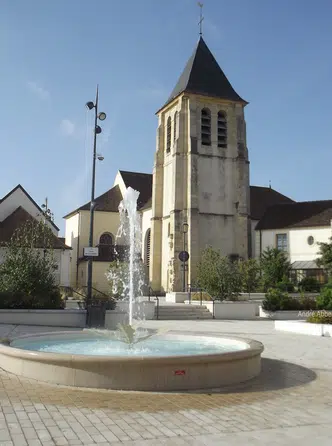
Ding... Ding... Dong!
– And why the carillon?
– Because – as our gazette says – we are on the first of November, the holiday, and the bells ring! Listen. !
– Do you know that in Neolithic we could hear the bells?
– Are you sure about that?
– In any case, historians say: from the moment man mastered the fire, he was able to harden the clay and realized various objects which, struck, gave a sound.
- Ah! If historians say so!
– Don't be so suspicious... I believe them when they write that we find in Asia traces of bells dating back 4,000 years.
- Pristi! What a leap in time! But here I also believe them.
– Suddenly... Like this! Why not?
– Because we're in the bronze age!
– You're not serious... Let us return to the 1st November: in 610, Pope Boniface IV decides that all the saints will be honored every 13 May. A large century later, Gregory III preferred November 1st and imposed this feast on the world. 1789: The French Revolution abolished this day, which was restored by Napoleon (1802).
In the 20th century, November 1st is part of the 11 holidays « listed in the French Labour Code ». Many – believers or atheists – take advantage of this day to flower the graves of the loved ones who have disappeared, mixing the feast of all the saints at the feast of all the dead. And the Cemeteries look like flower fields! On all the tombs bloom cyclamen, heather and especially chrysanthemum, the Marguerite of the dead, as Brassens writes.
– I love the poetry and humor of this man!
– You're not alone! It's not that I'm bored with you, on the contrary... But time passes and there is already November 2, the day of the dead... Maybe we can hear the gla...
Jeanne Monin
Research on several sites.

- The Echoes of the Week
Quiz of the week!
Gérard Lattier
Green olive, black olive
The two Jeannes - Passadoc
Quiz of the week!

Gérard Lattier
André Abbe
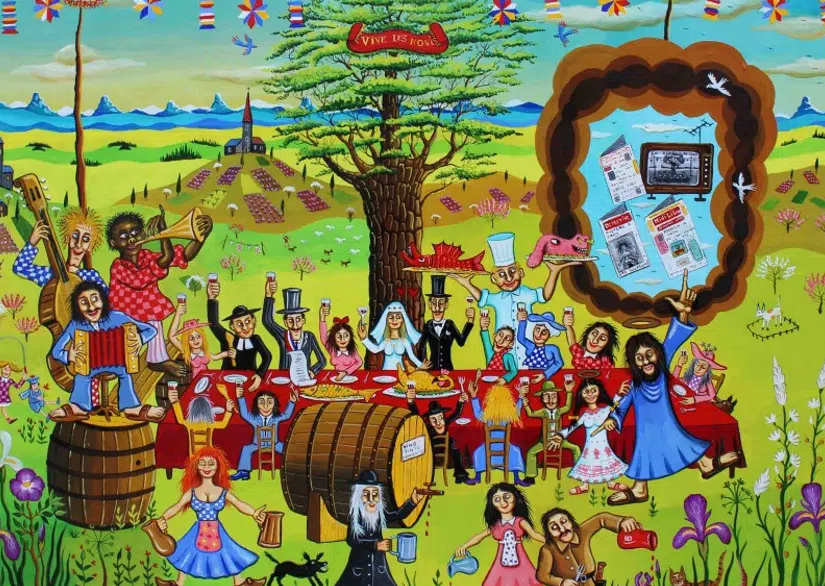
I found my friend Gérard Lattier at his home in Poulx (Gard), always good foot good eye, always in the middle of work.

Claude Boyer
Libertaire, anarchist. During the Algerian war, he simulated madness to escape service and was interned in a psychiatric hospital. A great admirer of Georges Brassens to whom he has dedicated works, Gérard Lattier paints a naïve art where the characters of Dubout mix with the bright colours of customs Rousseau.
Jean-Philippe Tinois
There are so many messages in this web.
Green olive, black olive
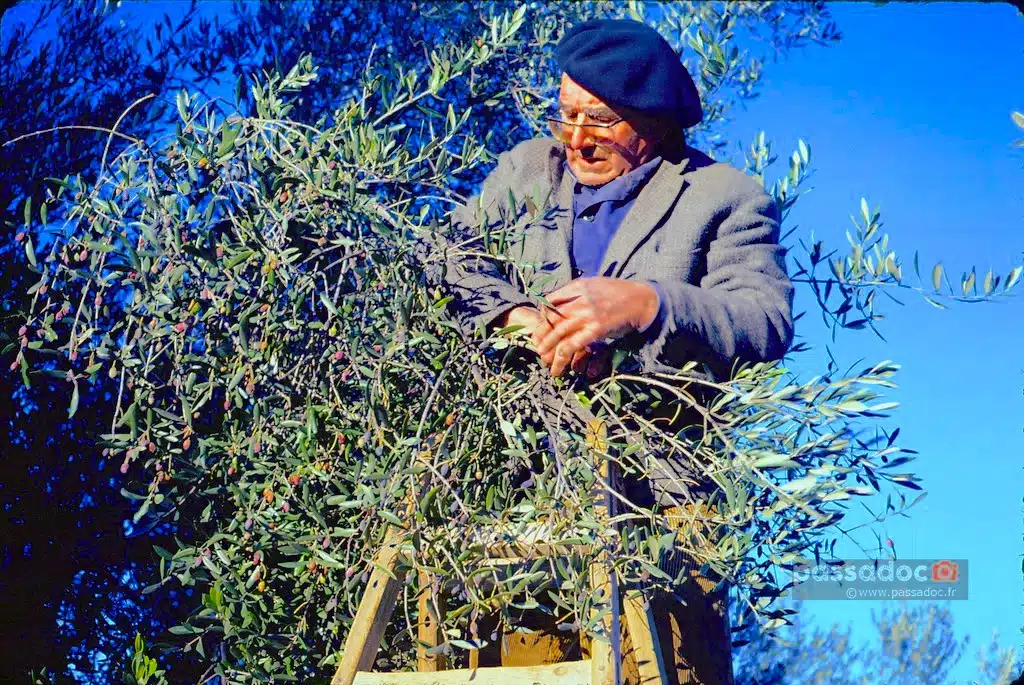
To this question, Bernard Molinier replied with a smile:
– If you plant the olive tree facing south it will give black olives, if facing north it will be green! It's the same for oranges!
The green olives are harvested from 6October and the blacks are usually after a few days of frost that makes them become black.
Greens are on Pichouline olive trees preferably, blacks on Nyons and other special qualities for black olives mainly used to make oil.
Denise Linsolas
– I thought you needed the gel for the blacks...
Jean-Philippe Tinois
– Pa) necessary: they mature black without freezing; But with frost, I think they become more pasty like cynorrhodons.
After you apply the method of industrialists to have black olives but firm as green, you have to make them undergo a chemical treatment in my mind totally inept but people buy. It tastes disgusting, stuffed with products, but it has a beautiful green olive shape that has become black!
It goes in the movement of « It's not good, but it looks good.« . It's like strawberries, tomatoes etc.
The two Jeannes
AEdré Abbe
Do you know the two Queen Jeannes?
They gave their names to places in Provence:
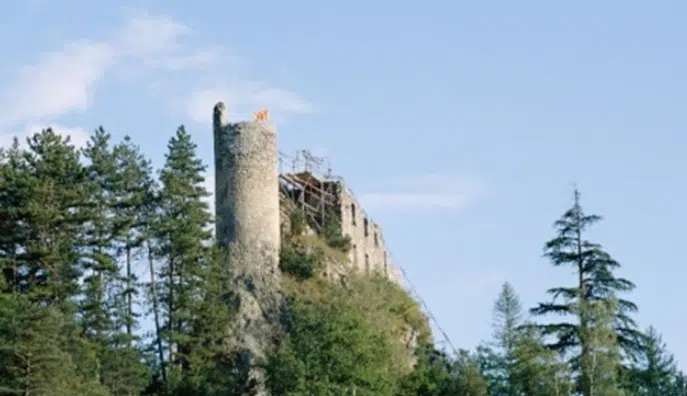
– There is the castle of Queen Jeanne in Guillaume in the Alpes Maritimes.
– And the Queen Jeanne Bridge in Entrepierres in the Alpes-de-Haute-Provence. There is also Queen Jeanne's tower, destroyed after the 1909 earthquake (Salon-de-Provence in the Bouches-du-Rhône).
Claude Boyer
Queen Jeanne is « Heroin » a very horrible legend.
[The Queen on returning from Mass, will find table set].
[A bad roche, a day will come when on your tops, no more roosters and chickens will sing, but only squirrels and other wild birds!]
Initially affected by an epidemic, Rocca Sparviéra gradually died, was destroyed by an earthquake in the 19th century and then deserted by its inhabitants...
Not to mention the famous lady-jeanne, this large bottle, of fairly large volume, which we all certainly had one day in our cellars and then in decoration, glass bottle with a very rounded shape and a fairly short neck.

Photographe André Abbe… photographié François Abbe devant un ordinateur aussi vieux que la reine Jeanne !
Elle est pauvre et sa table est souvent mal servie
Mais le peu qu’on y trouve assouvit pour la vie
Par la façon qu’elle le donne
Son pain ressemble à du gâteau
Et son eau à du vin comme deux gouttes d’eau
Gilbert Bécaud
Voir notre oncle après dîner
On les appelait tante Jeanne
Ce n’étaient jamais les mêmes
Mais on les aimait quand même
On aimait nos tantes Jeanne
Deux chansons proposées par Giselle Penat-Laborde.

Cited in The Gazette : André Abbe – Claude Boyer – Alain Cathala – Denise Linsolas – Monique Marcellino – Jeanne Monin – Giselle Penat-Laborde – Jean-Philippe Tinois.
Editor in Chief :Jeanne Monin.

