


Hebdo 189
Hat!
Elegance yesterday*...
It was a time – not so far away... – where it was not a good tone for a woman to go out « Hair », i.e., no hat, no cap, no hat, no damn thing, even if it was allowed for the workers.
Louis Lumière: December 27, 1895.
In very, very ancient times** (15,000 years!), the head covering is a way to protect yourself from falling stones, for example.
There are haired heads represented on Egyptian, Greek vases. In ancient Rome, the « pileus » is placed on the head of the freed slaves; It would be the origin of the Phrygian hat.
Over time, the hat will define the social class: for peasantry, coarse felt or straw hat with wide edges to protect itself from the rain or the ardour of the sun; for the rich and noble, refined shapes, fine materials, such as velvet. Women wear hats decorated with flowers, ribbons, feathers... Under Louis XV, under the Executive Board, they will sometimes be extravagant!
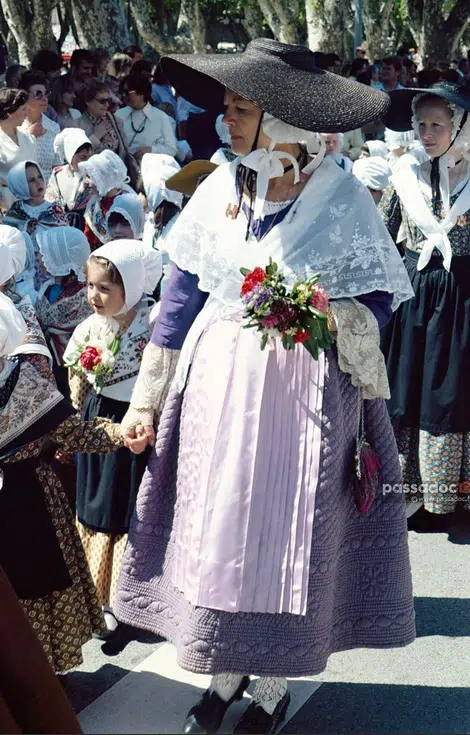
Every province, every region with its cap: the high cap of the Biguden Breton, the wide black ribbon of the Alsatian, the soberer one of the Arlesian whose pose is more complex than it seems, and of course the Nice hat!
To each shape of hat is linked a character: the melon of Charlot, the beret of Bonnie Parker, the felt of Jean Moulin... or that of Indiana Jones, Sherlok Holmes' two visor cap, Caesar's Panama (Marcel Pagnol), Frédéric Mistral's Gardian hat.

* Le Muy – Cheese Market – Photo André Abbe.
** Research on different sites –Jeanne Monin

- The Echoes of the Week
Wind and olives
The heights of the city
Fools!
Red inn
Between Saint-Aygulf and Sainte-Maxime - Passadoc
Wind and olives
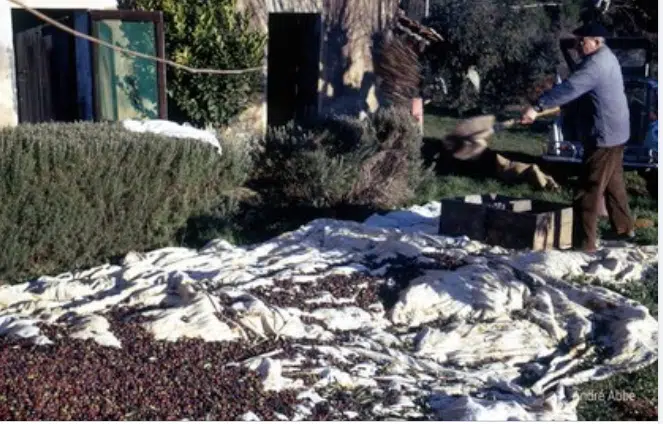
The wind can be the worst and best thing... A mini-tornade can cause considerable damage in the gardens.
The heights of the city
André Abbe
In 1974 I went to walk over the city of Draguignan. I had taken this photo of abandoned terraces asking myself what farmers could cultivate 50 years earlier, on these slopes that were not conducive to agriculture.
I never went back to this place again. I wonder what happened to him, 50 years later...
Marie-Hélène Joubert
In Provence, we talk about terraces, restanques; In the Ardèche, they say façasses.
Marie-Dominique Germain
In Seillans, they say banks.
Veronica Pepin
We also planted dried vegetables, chickpeas, lentils...
And now houses are planted everywhere!
Christian Bellone
Lots of cereal! We must not forget that before – about 1900 – few means of locomotion had to produce everything on site! Food first... Then came the war of 1914, and all the arms were lacking and the restanques often abandoned were garnished with pines, shrubs, vegetation occupying the space.
Patricia Jouve
It's there.olive trees!
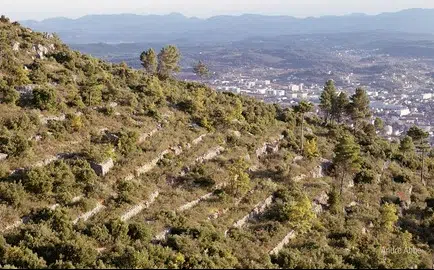
If it is – but I'm having trouble orientating – the hill of Malmont, everything is built or almost... same thing on the side of the Col de l'Ange, there are ancient restanques, planted once with olive trees and vineyards in certain places, with lots of land...
Fools!
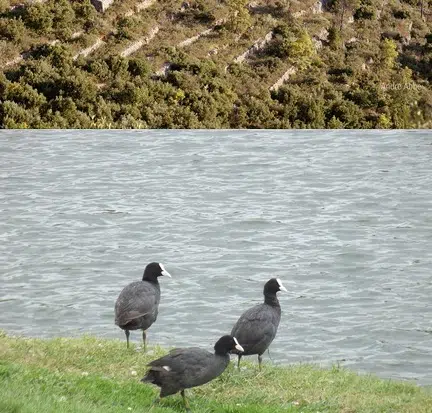
Here are some macroules, well recognizable by their white beak.
In Provençal, they are called macruso (macrusas), francized they become macreuses.
It is not a game but during restrictions some ate them.
First we had to « spy »remove the skin, no question of feathering them.
In French, the macreuse is another bird, nothing to do with the coffin.
If a friend invites you by saying « We'll eat macreuse. »Ask him to specify!
[Text and photo André Abbe].
Jean-Paul Tinois
If I don't abuse myself, the macreuse is also a piece of beef...
Claude Boyer
The macruso still passes; We at Puget were eating lamberts...
Although « ate-lambert » on the maternal side, I admit I never tasted it. That said, why not? When I said I didn't like something, my mother replied:
– When you're hungry, everything's good! And she was right... Doing the difficult is a rich sport with a full belly...
____________
« Traditions and heritage » (Pugetois website): These green lizards became the symbol of Pugetos while their Roquebruno neighbours were called the « Jumpers-Messugues ». Elders say that, in times of poverty, villagers would have consumed them; Others explain that this is mainly a reference to the local art of living: to take time and lick in the sun, as this little animal would do.
Red Inn
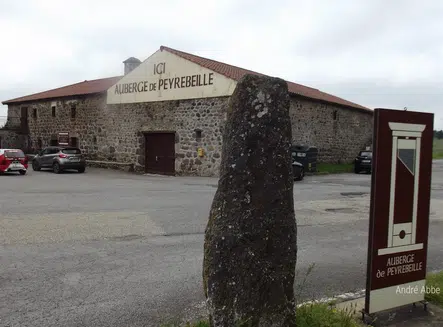
André Abbe
Between Aubenas and Langogne, in the upper Ardèche, I visited the inn of Peyrebelle, remained famous: in the 19th century, the couple of hoteliers assisted by his servant murdered their guests there, not all fortunately!
I had the chance to visit the hostel on my own, benefiting from an intelligent staging, sound and lighting. I almost got scared!
The three murderers were unmasked and executed on the spot. A menhir is on the guillotine site.
Claude Sous Lara directed a masterpiece of black humour in 1951 « Red Inn ».
Fernandel played the monk, Françoise Rosay and Julien Carette, the hoteliers.
The dialogues of Aurenche and Bost are tasty:
– He was an artist, he doesn't weigh much!
Claude Boyer
In truth there was only one victim, a certain Enjolras who was found dead by the side of the way. The only fact that connected him to the inn was that he had spent the night before.
The husbands Martin were actually victims of a cabal orchestrated by their accusers because of their political activism and the jealousy that their success had aroused. Up to their valet who was devoted to them body and soul, a poor, simple, ard echoed, and not at all « beyond the sea »... Everything else is just an urban legend that has a hard life.
Bernard Gineste
The judicial investigation rejected all the various gossip and accusations allegedly committed by the Martin consorts in this inn. They were sentenced, along with their valet, for the alleged murder of Enjolras.
This conviction is based on the last testimony at the trial of a wanderer who claims to have spent the night in the inn's attic and to have seen, at night, through the slots of boards, the Martins « occent » Enjolras; whereas the so-called Martin were no longer innkeepers at that time; the court did not move to verify the vagabond's statements; And the inn owners were not summoned to court either!
In addition, the nephew of the Martins, who was also charged, was acquitted. The judges were so eager to find any responsibility in the murder of Enjolras in the Martins, that they forgot to charge the nephew!
The film by Autant Lara is more of a turnip than a masterpiece.
Jeanne Monin
A masterpiece, no... But turnip is excessive! I remember some tasty dialogues like those of the confession of the innkeeper (Françoise Rosay) at the monk (Fernandel).
Between Saint-Aygulf and Sainte-Maxime
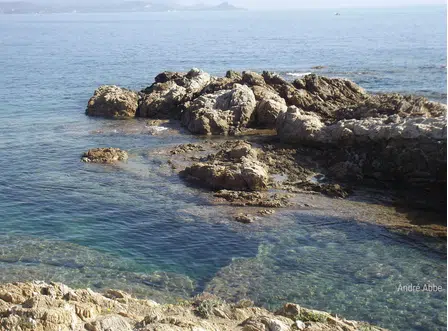
Between Saint-Aygulf and Sainte-Maxime (Var), don't miss the visit of the pesquier (live), an exceptional Roman site.
The Romans kept the fish they had caught there. The walls of the prison are seen, but they are now totally underwater.
Since the Romans, the sea has climbed at least 30 centimetres.
The site is about 100 meters from the road, the landscape is magnificent.
Hurry up and go, the sea level continues to rise...
[Text and photo André Abbe]

Some more photos of the evening « Passadoc – Intimate Provence » of 23 August

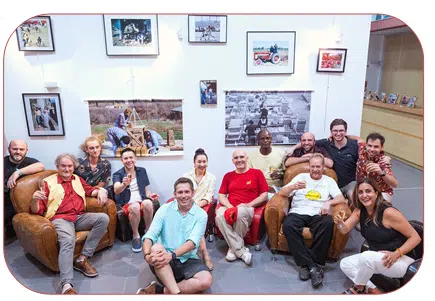
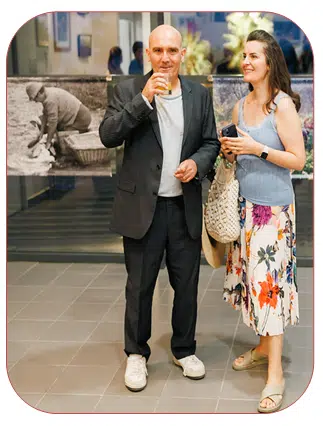

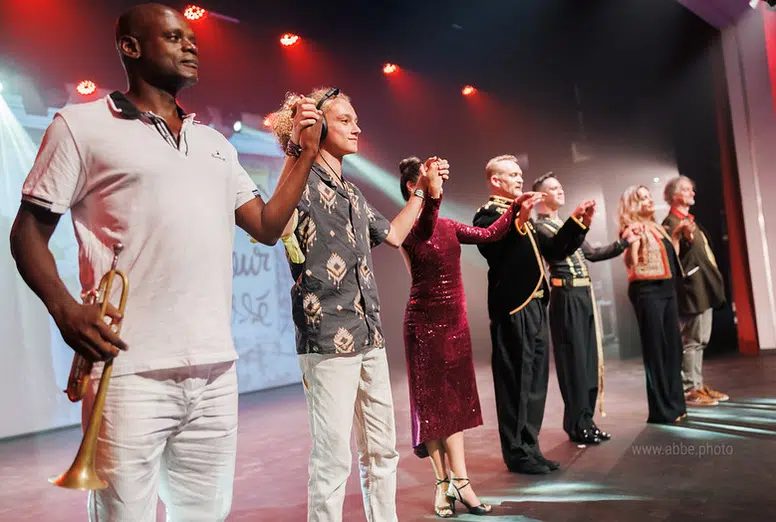
These are cited in The Gazette : André Abbe – François Abbe – Christian Bellone – Claude Boyer – Barnard Gineste – Marie-Hélène Joubert – Patricia Jouve – Jeanne Monin – Giselle Penat-Lavre – Véronique Pepin – Jean-Paul Tinois.
REditor-in-Chief : Jeanne Monin

