


The Hebdo 187
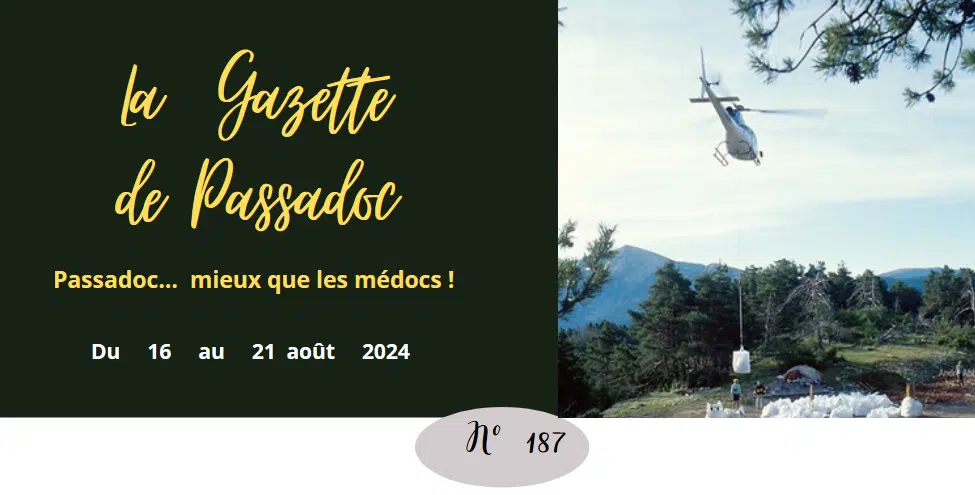
We're flying!
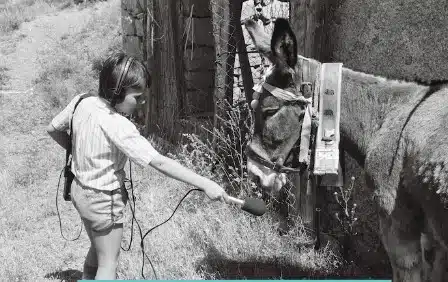
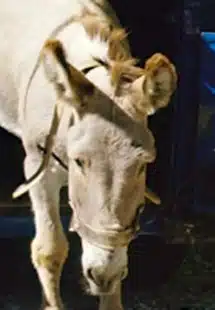
- The helicopter goes back and forth to transport the salt needed by the sheep on the pastures. In the past, this work was entrusted to donkeys, says André Abbe. Farmers are sometimes criticized for being hard on animals: they have released the donkeys from heavy burdens.
I took this photo about twenty years ago in the town of Thorame basse (Alpes-de-Haute-Provence).
But how long has this extraordinary aircraft been in existence?
Not to mention Leonardo da Vinci, who drew a « machine » whose rotor would be powered by energy would be human muscle.
Big leap in time!...
- 1907. Louis Breguet (1880-1955), built the first quadrirotor of history. On August 24, the first flight was 50 cm high and a few hours later, in the factory yard, the aircraft was 1.50 m.
- Between 1922 and 1925, Émile Berliner (1851-1929) experimented with experimental helicopters.
- Igor Sikorsky (American – 1889-1972) will leave his name in the history of aeronautics.
Of course, every year, research and technology will progress. Today, the helicopter is part of our life: it ensures the rescue of the wounded, the transport of the sick... various materials and materials... Military... and the salt transports that make his freedom to Cocotte, the star of Passadoc!
Jeanne Monin
Research on several sites.

- The Echoes of the Week
Squirrel and almond
80 years ago...
Roquebrune's private cafes - Passadoc
August 23rd!
Squirrel and almond
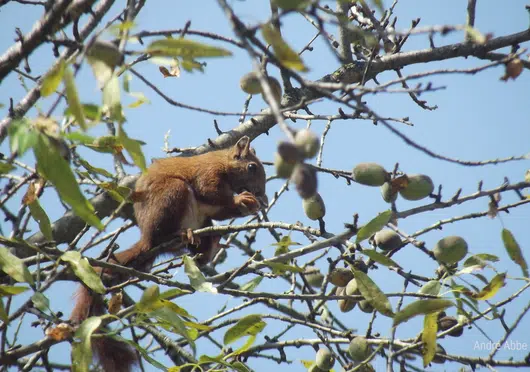
I recently complained about squirrels eating my almonds: they took everything from me! There's no more one left on my trees or on the floor.
I've spotted three of them, but they must be more numerous. Maybe the one in the picture is the father... or the mother; There are also two smaller ones,
One has a darker coat, the other has a white belly.
The show is over. It lasted more than a month because the squirrels attacked the almonds (green almonds). André Abbe
Mauritius Geneva – Adventure roads (Plon 1959).
Giselle Penat-Lorde
I greatly appreciate the writing of Genevoix, which is a very attentive, very subtle, very deep observer of the life of fields and forests.
In recent weeks I have reviewed some chapters of Those of 14, already read and reread in the past... Even in this war diary, devoted mainly to World War I, his descriptive style, exemplary, can be without damage compared to Colette's.
A wood, a field, a village, everything takes on another dimension with Maurice Genevoix...
80 years ago...
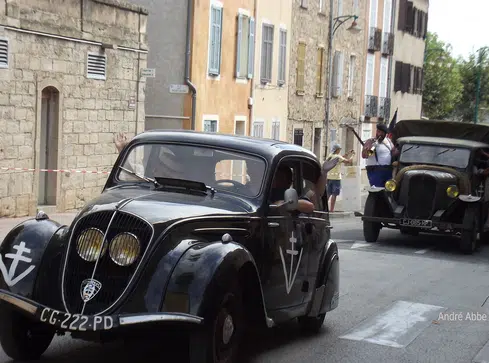
The 80th anniversary of the liberation of Sainte-Maxime...
André Abbe says:
At the liberation parades – the Muy in 2017, in Sainte-Maxime in 2024 – a superb 202 Peugeot passed before me in very good condition.
What is considered today as a collector car, was during my early childhood, chic chic, even with the Front Traction.
I was proud to go on Sunday in 202 of my sister's fiancé's father, my parents didn't have a car yet.
Roquebrune's private cafes

Does anyone among the Passadocians know why they call « circle » (ceuch), private cafes in Provence?
We had in Roquebrune, the Circle of Whites, the Circle of Reds and the Circle of Immigrants. We were talking about politics. Women were not allowed.
I think, but am not 100% sure, that this appellation of circles for coffees in Provence is a legacy of the Revolution.
Cyril R. Vergnaud
It seems that this goes back to royalty: « circle » is said to be an assembly which is done at the Queen's house, where the Ladies stand round her, where the Duchess have the privilege of sitting on a stool.
This room is the place where the Queen holds her circle.
Elise Savine
These circles also existed in Cotignac, red and white as was the case for both cooperatives at the time.
« Circle »... the word creates debate!
Jean-Philippe Tinois
Je ne suis pas copain avec le cercle,, je l’admire mais je le redoute ; mon pauvre esprit rationnel n’arrive pas à appréhender de voir une structure finie dont on calcul le périmètre, puis la surface, puis le volume avec Pi qui est une suite infinie, j’avais déjà ressenti cette impression quand je me suis posé la question de savoir dans quoi est contenu l’univers… les insomnies sont venues après, je crois !
Jeanne Monin
Remarque d’une prof. de math. qui lit par dessous mon épaule : « Pourquoi rester dans le plan alors que nous vivons dans l’espace ? Selon les philosophes grecs, la forme géométrique la plus parfaite n’est pas le cercle mais la sphère.
Pi est un nombre irrationnel certes ! mais c’est un nombre, un vrai ! Sa valeur exacte est Pi (la suite infinie est une valeur approchée en écriture décimale). Donc on connaît la valeur exacte de la circonférence d’un cercle ou de l’aire d’un disque« .
Symboliquement, en tant que figure géométrique, le cercle représente à la fois l’unité et le multiple, le tout (fini et infini). Par voie de conséquence, il symbolise l’harmonie, l’absolu, la plénitude. Et comme il n’a ni commencement ni fin, il symbolise aussi les notions de cycle et de renouvellement.
- Lien pour télécharger l’intégralité de la brochure.
- Pour en savoir plus sur les cercles ayant existé dans l’ensemble de l’aire provençale, lire l’article très intéressant que Pierre Chabert a publié en 2005 dans la revue Ethnologie française.
- Voir également le livre de 284 pages que cet écrivain, enseignant et universitaire marseillais, a publié en 2006 : Les Cercles, une sociabilité en Provence, Coll. Monde contemporain (Publications de l’Université de Provence). Références.
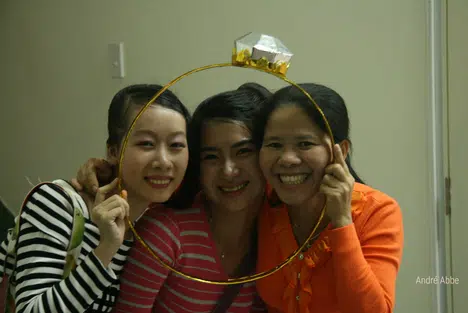
Soir de fête au Vietnam – 2007 [Photo André Abbe]

August 23rd!
Provence intime : un événement à ne pas manquer !
Mécènes et passionnés de Provence :
Entre culture, agriculture et voyages, soyez parmi les 100 privilégiés
à vivre une expérience unique le 23 août 2024 !
Vous serez au cœur d’une soirée exclusive, un verre de rosé à la
main, entouré de décideurs et de passionnés qui partagent votre vision.
Devant vous se dévoilera un fond de photos inédit : l’histoire de la
Provence et les moments intimes du quotidien des populations rurales ;
les Provençaux au travail et en fête ; les paysages pittoresques ; les
traditions culturelles en Provence et à travers le monde. Une sélection
des instants saisis par André Abbe, fils du pays, journaliste –
photographe – agriculteur.
Spectacle : Passadoc a invité 4 artistes internationaux qui arrivent de Dubaï, Londres, Marseille et Montpellier.
Pour tout savoir … Billetterie (réservation gratuite indispensable)
Cited in The Gazette : André Abbe – François Abbe -Éric Dussart – Jeanne Monin – Giselle Penat-Laborde – Élise Savine – Jean-Philippe Tinois – Cyril R Vergnaud.
Editor in Chief : Jeanne Monin.

