Passadoc Gazette – No 170

The weekly 170

Good as bread!

It seems that since the dawn of time bread has been the basic food of many civilizations. And if he fails, the hungry people revolt!

So in 1789.

But what are those screams? What do these people want? questions Louis XVI.
Sire, they're asking for bread.
"Well, let them be given brioche!"
would have exclaimed Marie-Antoinette present near her husband.

Legend... historians have searched, no archive does mention it.

Historically, Egyptians are attributed, « invention » Bread: […] from IIIecentury BC we already knew how to make breads with or without leaven because we had already noticed that the paste could ferment naturally, the Nile water, used by the first bakers, very rich in silts, was full of saccharomyces ferment, mushrooms that make up the yeast present*.

There are almost 80 different types of bread depending on the region, such as brié bread in Normandy, bent bread in Brittany, the baguette called Parisian, twisted bread (stressed) in the Midi. And multiple expressions** Some of which are little known:

There is no bread or house dough (it is necessary to do the shopping).
He's got more than half his cooked bread. (He will soon die).
He ate the king's bread. (he went to jail).
Good as good bread (do not be malicious).
Better bread in pocket than feather in hat (It is better to have something to eat than to offer extra luxury).
It's blessed bread (it's well deserved).
Winning Bread (substitute for his needs).
It's his livelihood. (it allows him to live).
Winning bread with the sweat of his forehead (sustaining by working hard)
– Pass the taste of bread (killing someone).
It doesn't eat bread (to say or do something of no importance, which is not vital).
– For a bite of bread (for almost nothing).
– Start eating his white bread (start with the easiest actions).
Remove bread from mouth (putting someone away from what is needed).
Go like buns (fast and easy sale).
Long as a day without bread (interminable painful situation, or someone very large).
Don't eat that bread. (refuse to do something that was proposed and not appropriate).
Having work on the board (initially: do not need to work; Since 1914-18, the expression has taken on the meaning of « have a lot of work).
 

Jeanne Monin

* Saint-Hilaire Abbey (Vaucluse).
** Research carried out by Claude Boyer.


This song is yours.
You're the hostess.I gave four pieces of breadWhen in my life he was hungryYou muttering your hive whenCrunchy and crispyAll well-intentioned peopleHave fun watching me fast
It was just a little bread.But he had heated the bodyAnd in my soul it still burnsLike a great feast
  • The Echoes of the Week
    A little quiz!
    Childhood memories
    Welcome to the village
    The beans

A little quiz!

Childhood memories

Claude Boyer
It was my job to go « give to animals ».
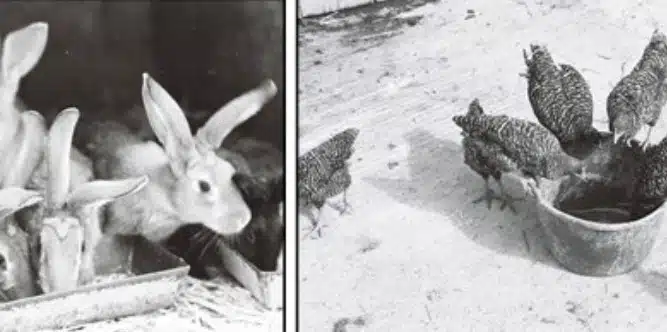
 
If I was proud of this mission of trust, I was no less leading it with some anguish to cross the big rat who had chosen to live on the beams supporting the roof from where he looked at me with his little black eyes. My childish imagination was imagining me jumping on and planting his impressive incisors in my arm.
 
The hens' grain was contained in a sheet of iron which had had to carry US or Germanic gasoline some 25 years before. This barrel was closed by a heavy wooden lid to prevent the rat from coming to collect his paper but it did not prevent the small mice from slipping into it.
 
To grasp the grain an old pot was used whose handle was extended by the wood of a broom ligatured with wire. My small size then forced me to press the belly on the edge and plunge the head first to grasp the pittance of the hens and so I disturbed the mice running in all directions, but they didn't impress me and I even enjoyed catching them in my pan.
 
Then came the rabbits who were hurting me because, if the hens spent the clearest of their time in the open air, they were cloistered in their clasp at the bottom of the henhouse and only saw the light of the day to be bleeded and peeled by Meme.
 
I also had to harvest the eggs and that was my favorite task, laughing in advance at the « side-by-side » Indignant about the laying women I hunted to harvest their laying.
 
It took time to understand why a cock had been introduced into the bassyard, and why from that day onwards it was necessary not to collect the eggs... who turned into cute little yellow and duvetous balls that were peeing following their mother while the cock, finished with wine in the casserole but this one in cast iron.
 
As I marvelled at the immolation of the cock, it was explained that he was no longer needed, the feathered flock was renewed.
 
It would have been so much easier to explain the things of life, but at the time « We weren't talking about that. » Even when it came to the reproduction of the gallinaceae.

Welcome to the village

André Abbe
Going to Roquefort-les-Pins (Alpes Maritimes), where I once had good friends, I had the pleasure of finding that the Provençal name was present on the entry and exit signs.
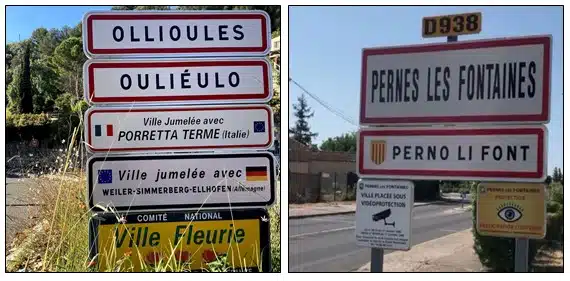
I enjoyed that « lei Pins » This addition is recent.
Once there were pine trees in all the towns between Grasse and the sea!
Additions can be useful. We added « on Argens » to my Roquebrune because there exists Roquebrune Cap Martin, near Menton.
 
The extension « in Provence » I think it is superfluous, many municipalities have adopted it to please tourists. Between Arles and Saint-Laurent-du-Var, we are in Provence, once and for all.
Unless, now that our region is called « South »It is necessary to specify that Provence still exists.

Jeanne Monin
For many years, all over France, the names of cities have also been displayed in the regional language... If there is one of course!

If today it is accepted everywhere, it was not always the same.
 
In the 1970s, Pierre Gabert, the mayor of Pernes-les-Fontaines (Vaucluse), was wind-up against a 1967 law which « obligation to reserve entry signs for French and the simple indication of the name of the municipality ».
 
So there's English everywhere with no reaction from the public authorities, but we should denigrate our Provençal language and throw it into the ditch.Is he insurgent? Not without reason.
 
He's not alone! Everywhere, one manifests, one scrolls with high flags in the colors of the region.
 
The passing time, the revolt – which was not just that – was calmed down. Is the law repealed? I don't know.
 
If one day, lost in the mist there where the earth ends, drowned under heavy showers*, you catch a panel that announces « Degemer matte« , don't be afraid for these strange words: it is simply Brittany that welcomes you!

*The legend says it's still raining in this region!
Claude Boyer
We also added « on Argens » to my Puget to differentiate it from Puget-sur-Durance, Puget Théniers, Puget Rostang and Puget Ville...
 
Note that Puget comes from « puy » (promontoire) for example Le Puy de Dome, Le Puy en Velay...
 
There is hardly just Puget City that is not strictly speaking located on a promontory.
 
Puget, Poget, Pouget, Pougeot, Peugeot are also surnames and have the same etymology from the puy.
 
I wish my own Puget was called Puget-en-Provence.


Jerèm Sauvan

Lou Tresor dou Felibrige (Frédéric Mistral):
 
Provence, the country of France bounded to the east by the Alps, at the south by the Mediterranean, at the west by the Rhône and to the north by a line that can go from Embrun to Saint-Paul-Trois-Châteaux.
Nice and Monaco are part of it and Aix is the capital
 

The beans

André Abbe
In Provence, beans arrive on our plates at the same time as the beautiful season. We like them with all the sauces, with the salt alone, with soup.
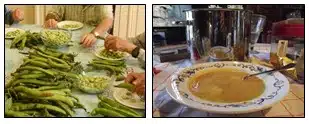
A lucky man, favored by nature is described as « favat ».
The bean is in our King's cakes. It's a separate plant.
I never understood why they said in francitan (local French) « Go make yourself some bean soup. » To someone we wanted to send somewhere else!

Someone among you might know.

(Photo André Abbe).

Why is it said? « Go make yourself some bean soup. » ?

Jean-Philippe Tinois
Maybe it just gives you one reason like another for the person to leave you alone... And as it takes time to shell, whoever said that the first time had this idea in mind and then it got out again!


Claude Boyer
Maybe it's because the bean is not considered a vegetable. « noble » and that it is quoted in this expression that is despicable... Just guessing from me.
I also heard « Swallow the beans with the cake » which would mean « failure to meet its responsibilities », i.e. swallow the bean so that it does not have to pay for another cake as traditional...

Angelo Del Tabor
Scotching beans blackens fingers and nails! Eating it makes sleeping good nights of deep sleep...
The bean leaf salad (terminal tips of the stems, picked after the end of flowering and the formation of the lower pods) is a dish that I like and good sleeping!


Giselle Penat-Lorde
I have been enjoying myself since the season started and do not miss buying from our good producers in the market of Draguignan.
I often eat them with salt or butter crunch, salad, I also cook them like peas, and also soup especially at the end of the season. Many recipes to accommodate the fresh and crisp beans. Also in the form of puree, velvety and bean cream
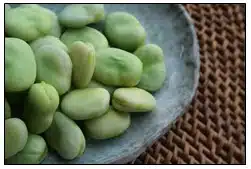
Remembering my childhood, my father planted it every year, like peas elsewhere.
 
As a child, I helped mom to make the soup with beans, and I had to remove the skin very carefully, cut them in 2... I confess that it had, while passing, begun to take turns of chores, a real work of Sisyph – Sisyphusarbeit – as it is said so well on the other side of the Rhine! All black and peaty fingers... But, well, I was bravely executing and monitoring the filling of the bowl by sighing and staring in desperate air at the heap that remained and that did not seem to diminish ...
 
I remember that they were made to dry and that Mom also had some good recipes to cook them (soups, purees, ragouts with potatoes and bacon, etc.) They were first soaked for at least 12 hours.
 
Je pense aussi que mon grand-père paternel avait ramené quelques bonnes recettes de fèves, bien épicées et parfumées, du Maroc, où il s’était engagé durant la Guerre de 14-18. Il ne manquait d’ailleurs jamais de s’approvisionner en épices à Marseille…
 
J’avais retrouvé ces saveurs en mangeant justement chez une amie marocaine des fèves à la « chermoula » (sauf erreur ou confusion de ma part) durant mes études à Nice, ce qui ne date encore pas d’hier …
De vraies madeleines de Proust, faites de parfums, d’odeurs, de saveurs et de mille souvenirs colorés …
 
  • These are cited in The Gazette :
    André Abbe
    Claude Boyer
    Angelo Del Tabor
    Jeanne Monin
    Giselle Penat-Lorde
    Jerèm Sauvan
    Jean-Philippe Tinois


  • Editor in Chief
    Jeanne Monin

Passadoc