Passadoc Gazette – No 159

The Hebdo 159

You said left-handed?

Left... A particularity that in ancient times it was better not to have!

  • For the Catholic church, the left-winger is Satan's servant and for Islam, the left hand is unclean.
  • Superstitious Peter the Great forbids left-wingers to testify in court.
  • To enter the holy places, Pythagoras recommends using the right side which is divine.
  • In the Middle Ages, great misery for who is left-handed... and red! A woman suffering from these two « pain » is condemned to the stake.
  • Maori women shake their wedding clothes with their right hand; Using the left hand would awaken death.
  • Along the Niger River, preparing food with the left hand is to resort to black magic.
  • In France, in a treatise on psychiatry dating back to 1921, being left-handed is synonymous with dementia.

We could multiply the examples because the list is still long!

  • Have peace for the left-handed! Ancient Peru where to be left-handed is a sign of good luck.
  • And an annual and global event: International Day of left-handers (13 August).

According to recent statistics, left-wingers make up 10-15 per cent of the world's population. Researchers recognize, their artistic senses or their highly developed sports qualities and quote Leonardo da Vinci, Michel Ange, ... or Rafael Nadal.

They're smarter than average... one day they'll dominate the world! Calm down... and not panic, there's 90 percent human left to bring them back to reason!

However, everyday gestures are not always easy for them because everything is done for the majority, starting with scissors!

All this is beautiful... but where is our left-hander?

Patience... here he is!

Jeanne Monin

Research on many sites.
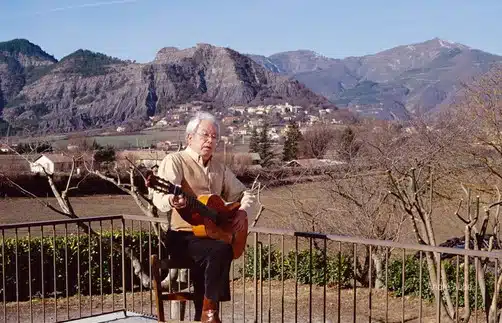
Marcoux - Alpes de Haute Provence


Photo of the late Peire Pascal, author of the most beautiful texts of songs in Provençal.

He holds his guitar from « Bad side ». Probably he was left-handed, I never asked him the question. In fact, there is no bad side, both are also good.

In France, there would be 7% left-wingers. They are more numerous in percentages in my village, among the families present before 1900. I've been investigating.
At kindergarten, the mistress gave slaps to force me to write with her right hand. I'm now clumsy with both hands.

In Provençal left-hander is said to be senequier. This particularity gave a common surname. There is a famous café of this name in a famous seaside resort.

AEdré Abbe

Patricia Jouve
I love her texts! Two CDs of songs I know by choir! A wonder of sensitivity! And what a writing! in a language that he possessed perfectly dau breç. His songs are a true testimony of the rural life of this past era.

Giselle Penat-Lorde
My brother Guy was also a left-winger (from Roquebrune) upset with stings in support, the super-method of the era used both by my paternal grandfather, the patriarch, and by teachers and schoolmasters, while my parents were largely in favour of the use of the left hand and against these stupid punitive measures... But were they entitled to the chapter at the time?

Not a very positive result in fact. If it is not that my brother was still later ambidextrous, especially by DIY in mechanics and various, encouraged to the army, if my memories are good, by an officer in Algeria, who had had to detect gestures and reflexes of left-handedness...
 
I also know Peire Pascal and some of his songs, including « The mala reputación« , (translation in Castilian for Georges Brassens, « Bad reputation ») « L-Arlatana » accompanied by Paco Ibañez).
 
We had some records at home... Old memories lost in some move.. So much, yes, beautiful songs, full of poetry, in turn cheerful, ironic, nostalgic, tender and naughty ... a great gentleman, certainly the best singer of our Provence!

For whom knows the Provencal, Jean-Jacques Murat wrote:

From "lei nièulo de ma prouvènço courroun davans lou mistrau" (l-americo) to "viravon lei tarara au tèmps de cauca lei blad" (the cavalo) passing through "la fouir de ton say that a so much fa vuvounia l-eissam dei cuou beni" (l-a-ami), "e nautre lou femelan nous dounara ges de fèbre" (la fueio), "saabre to vousre bèuta se mei cambo an de feblesso" (la valso), "e meme fau proun vièi queajougni vèire sus toun pèu negro levado", "avên pas inventa la poudre, mai lou plouumb sabèn doun vèn" (la valso), "e meme fau prouun vèi" (lubune ubeu du veuvou a feu how many wonders of poetry, of tenderness in this language of experience, in its time and space, embodied in its songs ...


.
The particularity of Pierre Pascal, the notes of music
and the music of words awaken memories. Let's talk, we smile!

Saint Tropez... Senequier... School... And here's the surprise:
We have the same last name... Would we be cousins?

47 comments for the only day last Saturday!
That's Passadoc too!
.

  • The Echoes of the Week
    The Guardian Angels of Passadoc
    Pauline and Mireille
    Strong friendship
    The goat of La Madonna de Fenestre
    The dance of the strain

  • Passadoc
    Expo. and leporello

The Guardian Angels of Passadoc
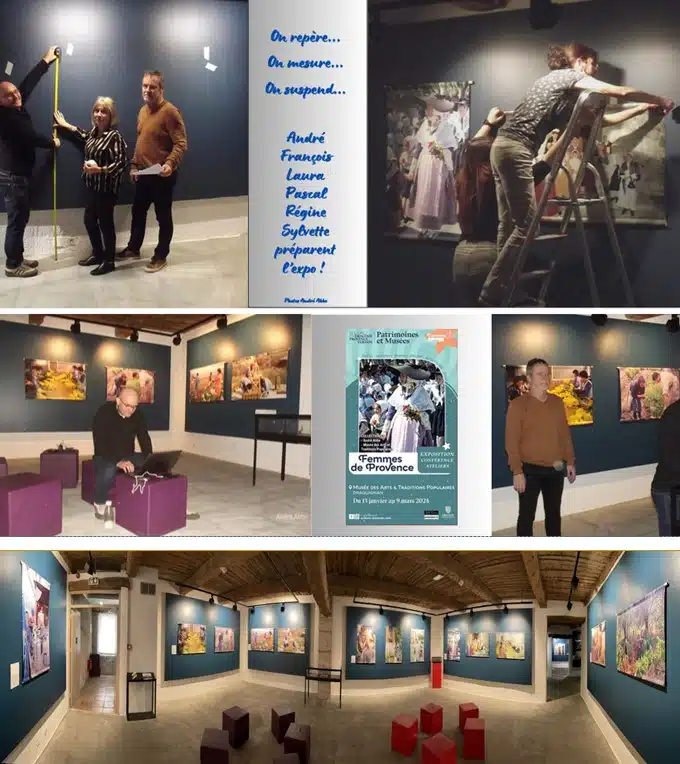
So much work accomplished, hours spent since the invention of the name "Passadoc" with Christophe Malherbe in 2014!
 
Team of both associations « Passadoc » and « Abbe Photo » are surrounded by guardian angels. The list is long!
 
When we set up the exhibition "Women of Provence", the guardian angels called Régine, Patrice and André (Passadoc), as well as Laura and Sylvette (ATP Museum of Draguignan). We installed in one day. It was a hell of a job!
 
You too behind your screens play the role of guardian angels: every day you "like", vo comment, you share, you talk about Passadoc around you.
Thank you all!
 
François Abbe

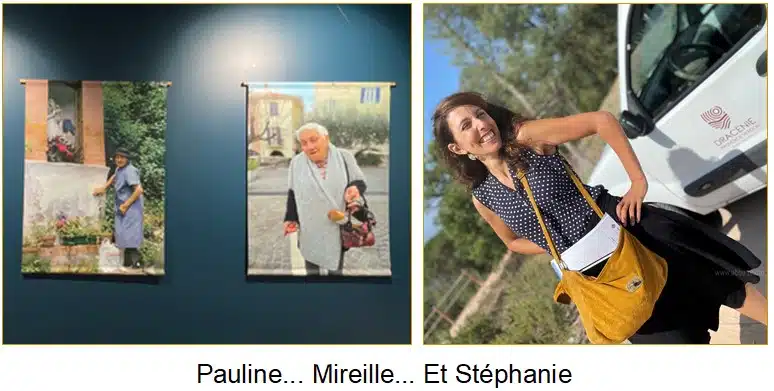
Pauline and Mireille

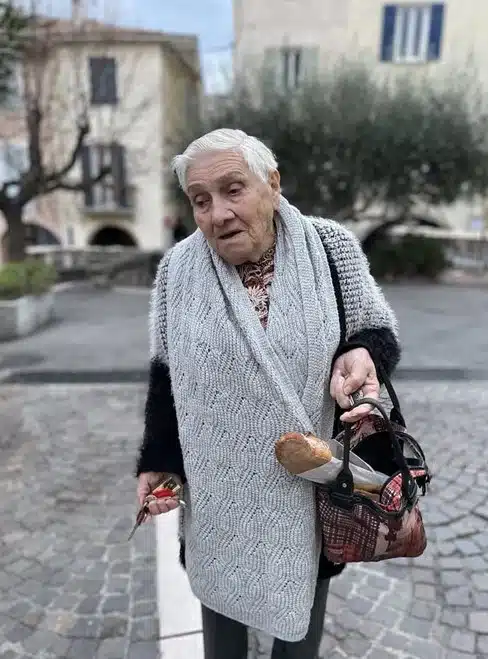
Pauline and Mireille... two stars from the exhibition Women of Provence !
 
Both had the responsibility to open and close the church. Pauline lived in Rigaud (Alpes Maritimes).
 
Mireille had another role: that of "Mami of the village" (it was Stephanie Dahan who blew the term!). Mireille and Stephanie lived in the same village, Roquebrune-sur-Argens (Var). They knew each other well. Stephanie even invited Mireille to come and see the exhibition "Women of Provence" that she organized. But Mireille died before the opening.
 
Meanwhile François (who writes these lines!) learn more about Pauline. Without knowing each other, the two women had so much in common. So, at the last minute, he decides to add Mireille's photo to the exhibition.
 
In the exhibition, there are photos from the iconotheque of the Museum of Popular Arts and Traditions (9,000 photos kept under the responsibility of Sylvette Albrand) and photos of André. Then why add Mireille's photo?
 
On social media, the public loved the history of these two women. Then Mireille's picture had its place!
 
 
Upon his return from leave, Stephanie discovered the exhibition. And the surprise: his friend Mireille was there! The Grandma of Roquebrune is the permanent guest of the "Women of Provence"!
 
François Abbe
 
Stephanie is Head of Heritage and Museums at @Dracénie Provence Verdon Agglomeration. It is in Stephanie that we are invited to exhibit for the first time in a museum stamped in France; thanks Stephanie on behalf of our two associations Passadoc and Abbe Photo.
 

Giselle Penat-Lumbe
So many good memories of Mireille!
Unless I was mistaken, in her youth, she had lived on Rue des Douanes, not far from home.
 
And I had found it much later when I lived a few years at the 6th of the Barbacane impasse in the house of my maternal grandparents, before returning to the large family house on the Rue des Douanes in the low neighborhoods of Roquebruno.
 
I have above all warm and moved memories when my brother died in September 2000, followed by the year after Mother's tragic. Mireille was more than present on many occasions...
 
We met regularly at the cemetery, at the church, in this high part of the village and it often sounded at my barbacane door, just to take my news, if she hadn't seen me in a few days, and those of our « twin cats », Sido and Sacha, whose mother spoke to her so much, Two kittens a little turbulent who were Mother's sweet companions...


Strong friendship

Small holiday friendship for these kids who every afternoon meet on the beach, build castles, jump into the waves screaming with joy... A friendship that many years later still lasts...
 
Gift of life like the one André Abbe tells:
 
In 1967, an accidental meeting on a Lyon road changed my life.
André Laffont, a traveller with a big heart, offered a stop trip. This spontaneous generosity forged an unwavering friendship through years and trials.
 
Beautiful surprise of life like that of life based on solidarity and respect for nature. Our families have intertwined, sharing unforgettable moments, weddings and warm meetings.
 
André Laffont, a model of altruism and sustainable life, leaves a legacy of strong ties and precious memories.
Photo J.M.

Roya 06 

The same friendship for these kids who every afternoon meet in the hamlet square of Roya, do collective games, descend to the river shouting with joy, climb to the pastures see the shepherds... a friendship that many years later still lasts.

The goat of La Madonna de Fenestre

André Abbe tells the story

Maybe you don't know I can milk goats! I had learned from my chevrier friends in the Garrigue Gardoise which produced a delicious pelardon; I've never found such good anywhere else.
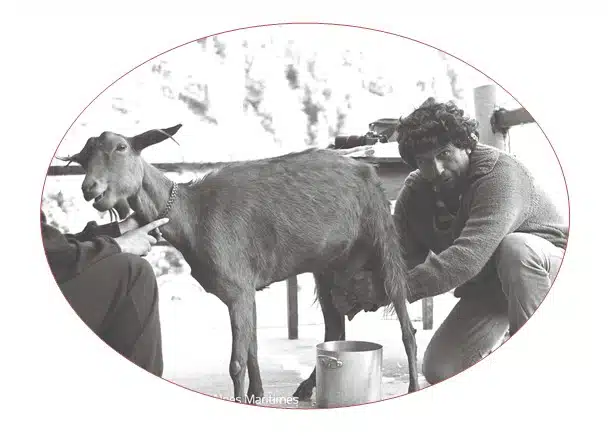
During the summer of the 1980s, in La Madone de Fenestre (Alpes Maritimes), I participated in a meeting with the themes of pacifism and non-violence. Big subject...
 
On the return of a walk to the Fenestre Pass, bordering Italy, I had found a goat who had separated himself from the flock of the sheepfold of the place. I had taken him back to the chalet in the diocese. Her breasts were swollen because she had not been treated for several days.
I had taken a saucepan and made the goat, which had aroused the esteem and admiration of my friends.
We shared the milk and then I brought the goat back to the sheepfold. His masters were not aware of his absence.
 
J’avais oublié cet épisode avant que François m’envoie cette photo. Vive la numérisation des négatifs qui rafraîchit la mémoire…
En fait, je l’avoue, il n’est pas bien difficile de traire une chèvre ; bien traire est une autre affaire.
De nos jours, la traite est devenue mécanique chez les éleveurs. Plus besoin de savoir bien traire pour produire un bon pélardon.
 
(Le pélardon est un très petit fromage au lait cru de chèvre.)
 
Cette photo est l’une des 100 000 de la collection d’André Abbe. Notre association à but non lucratif doit encore numériser et sauver 87 000 photos. Vous voulez nous encourager ? Suivez-nous, likez, commentez, partagez !

Une dernière chose : ne manquez pas La Madone de Fenestre, à une heure au nord de Nice, une destination magique, bien que populaire. Allez-y tôt le matin pour profiter au mieux de son charme !

The dance of the strain

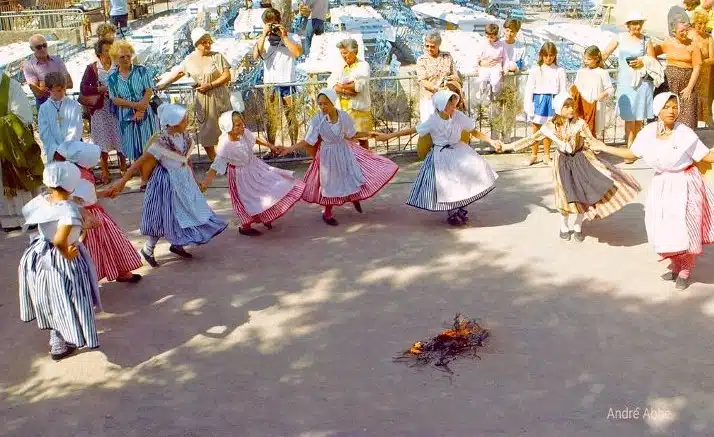
Qui connaît la Danse de la Souche ?

Tout commence par un cep de vigne. Après la messe, le prêtre bénit cette souche.
Ensuite, on danse au son des instruments de musique provençaux : galoubets et tambourins.
 
La chanson utilisée est l’air des Grâces de Saint-Marc. Les paroles sont un mélange de provençal, de français et… de grec ! Cette danse festive est donnée en l’honneur de Saint-Marc.
 
On ajoute à la souche un bouquet de fleurs et un épi de blé. On jette ensuite la souche dans les flammes. Il s’agit du symbole de la renaissance de nouveaux plants de vigne.
On danse autour de la souche. Une fois le feu terminé, les cendres symbolisent la terre. Cette danse peut se faire après les vendanges ou tout simplement à d’autres moments de l’année. Encore une belle célébration provençale.
 
Une question subsiste : pourquoi Saint-Marc est-il considéré comme le protecteur des vignerons ? On lit souvent que Saint-Vincent est le Patron des vignerons…
 
François Abbe

Marie-Dominique Germain
… aussi pour la fête de la transfiguration du Christ (qui a Fréjus est devenue la Fête du Raisin) avec un indult depuis le 4e siècle pour la cathédrale de Fréjus car on verse le jus d’une grappe de raisin dans la coupe de vin lors de la consécration au lieu de l’eau habituelle qui représente notre vie associée au sang du Christ.

On ne danse qu’après la messe et toute l’année lors des fêtes religieuses. La symbolique n’est pas lié à Saint-Marc, ni aux vendanges, ni à la renaissance du cep de vigne mais à la résurrection : celle du Christ et la nôtre.

Le feu est celui de l’Esprit et les quatre filles correspondent aux quatre coins cardinaux, c’est-à-dire l’ouverture au monde. C’est un peu résumé mais je pourrais développer !


Ghislaine Manjon
Je connais pas cette tradition, mais je suis amatrice de tout ce qui touche la viticulture ; j’avais décoré ma maison à l’image du vin, de la vigne, des outils de vendangeur osco !

  • Giselle Penat-Lorde
    Saint-Marc, Saint-Vincent, concurrence entre les saints patrons de la vigne selon les régions, les terroirs viticoles et l’époque !
  • Saint Vincent : Patron des vignerons et des vinaigriers
  • Saint Marc : Patron des vignerons – aussi patron des éleveurs de bovins et ovins
  • Il y en a un troisième, également patron des vignerons : saint Werner et/ou saint Vernier dit saint Verny en Auvergne.
Et ce n’est pas tout, puisque pas moins d’une trentaine de figures saintes sont réputées œuvrer pour la protection de la vigne et du vin, dont Saint Martin, saint Morand, saint Urbain, saint Victor …
 
Cette grande diversité trouve son origine dans l’hagiographie des martyrs, où le vin est souvent assimilé au sang versé.
 
Cependant l’adoption d’une figure de culte par les vignerons peut être liée à la vie du saint elle-même, telle que la rapporte la légende :
 
  • Selon les vignerons de la région de Tours, par exemple, c’est saint Martin qui aurait introduit la culture de la vigne dans le val de Loire, et son âne aurait même découvert le principe de la taille en broutant une vigne ! Au fil de l’année, différents saints peuvent être invoqués à des moments critiques pour la végétation de la vigne : saint Morand, célébré le 3 juin, est ainsi censé protéger des gelées tardives et favoriser une bonne floraison.
Au XXe siècle, le culte de saint Vincent sera le plus répandu. Il semble avoir son origine en Île-de-France, où les viticulteurs dépendaient autrefois de l’abbaye éponyme, devenue par la suite Saint-Germain-des-Prés. Après quoi il se serait étendu à d’autres vignobles.
 
Quand je travaillais sur Lyon et que j’habitais un temps au cœur d’un vignoble du Beaujolais, c’était davantage saint Vincent en général qui était mis à l’honneur.
 
Pas mal de confréries en Provence et en Occitanie portent le nom de Confrérie de Saint-Marc. D’autres de Saint-Vincent. Certaines sont très anciennes et remonteraient même au X° siècle. Telle la Confrérie de Saint-Marc à Villeneuve-lez-Avignon.
 
La fête de la Saint-Marc en avril, initiée par les confréries, trouve son origine dans les antiques fêtes païennes :
 
  • En Gaule, le culte de Bacchus, dieu romain de la vigne et du vin, était répandu jusqu’en Provence, alors pays des vignes.

    Cette divinité romaine et ces manifestations sont issues de la mythologie grecque et de ses fêtes, Dionysos et les « Dionysies ».

  • La fête de la Saint-Marc s’apparente aux fêtes romaines dites des Robigalia en l’honneur de Robigo, divinité que l’on invoquait afin de préserver le blé de la « nielle », ou rouille des plantes.
 
The Danse de la Souche, ou Brande de Saint-Marc, est apparue très tôt au sein des confréries provençales – dans un mélange là encore de profane et de religieux.
 
« Danse des vignerons, exécutée au Moyen-Age le jour de la Saint-Marc, elle est caractérisée par les saltations et l’oscillation constante du corps. Les sauts du danseur manifestent la prière à Saint-Marc et rappellent le geste des vignerons foulant le raisin.
Les danseurs exécutent ensuite un branle en chaîne, en criant « Vivo la Souco » et « Vivo lou maiou », entrecoupés d’un chant des « Grâces de Saint-Marc.« 
 
Chaque confrérie, si je ne fais pas erreur, a d’ailleurs ses propres rites, chants, danses, remis au goût du jour depuis quelques années, toujours dans le respect des traditions.

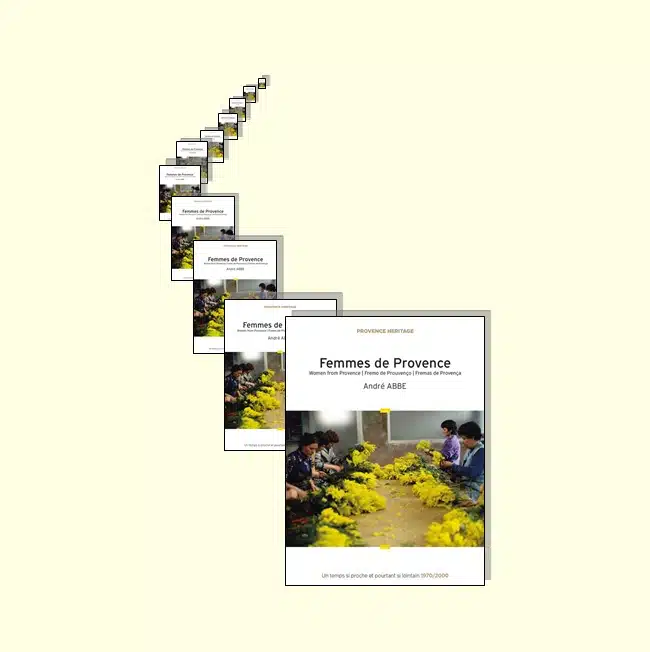
Expo. et Leporello !

Poster-exhibition-2024-women-of-provence
  • These are cited in The Gazette :
    André Abbe
    François Abbe
    Claude Boyer
    Marie-Dominique Germain
    Patricia Jouve
    Ghislaine Manjon
    Jeanne Monin
    Jean-Jacques Murat
    Roya 06

  • Editor in Chief
    Jeanne Monin

Passadoc