


Hebdo 151
There's plenty of lights...
Today, we hardly imagine Christmas without illuminations... Just December begins when the trees of avenues, squares and plots, as lanterns and candles, are enguirlanded. « Electrical » are everywhere in shop windows, balconies and city gardens.
Around 1960 the first bright decorations appeared timidly in the cities. Currently, it is everywhere a debauchery of lights especially since the light bulbs appeared « led–low consumption ».
We can't talk. « garland » not to mention Edward Hibberd Johnson* To whom we owe the first electric garland!
– Where are our lights?
Patience... here they are!
Jeanne Monin
* 1846-1917 – Inventor near Thomas Edison, born in Pennsylvania, creator of the first electric garland → 1882.
Research on various sites.


- The Echoes of the Week
That's rubbing, stinging.
The oil mill
Hello, Mrs. Laugier...
Chicken life!
Mrs Colvert and Mr Mulard - Passadoc
From Draguignan...
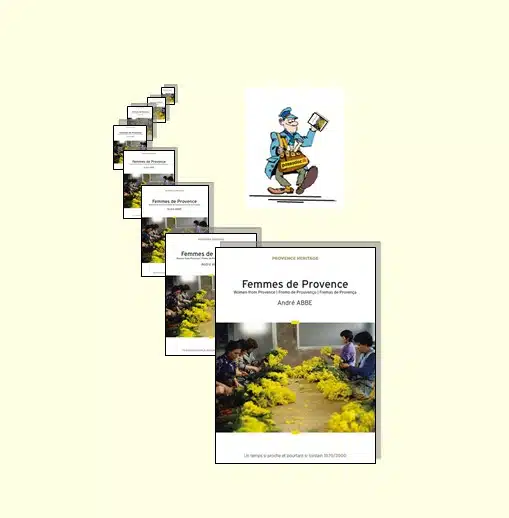
Discover your book!
Who rubs himself in it, takes a bite.

François Abbe
This is a mammalaria, or rather one of the mamillaries. This species counts about 120!
All this to tell you that this photo archive is 39 years old (to something near Jeanne's age and mine combined... At least in our heads!!!). The rendering after scanning and color adjustment is crazy isn't it?
So, as we say, as we repeat, you, too, digitize your photos and make them known through Passadoc For example...
Claude Boyer
In the immense white sea that is the Salar of Uyuni in Bolivia where I went a few years ago, there are many small islands. One of the most famous is Incahuasi Island.
Its curious and unique inhabitants, giant cactus called cardons, survived with stoicism for thousands of years in one of the most arid and harsh ecosystems on the planet.
Really spectacular...

The oil mill

Photo taken around 1970 at the oil mill Eugene Mauro in Draguignan (Var).
The Citroen is outside the door. The olive bags too!
André Abbe
The end-of-year celebrations cause a multitude of trips that allow family reunions. All means of transport are used: cars, trains, buses, planes and even boats by the islanders.
I remember that in my early childhood we settled on the stage of our B14 when we left to share the Christmas meal with parents. There were only two seats in the cabin, including the driver's.
No one walks around France on the road to motor vehicles, safety. But in many countries, truck trays still accommodate travellers. That's too bad for security.
Claude Boyer
At the back of his Juva 4, my grandfather had crafted two removable seats which he installed depending on whether he needed a van or to carry passengers; Then he bought a 403 tray where three people could sit in the cabin but when we were more numerous, as to go to the ponds of Villepey pick up the lovisses and picnic with family we were in the dumpster sitting on jute bags.
It is difficult today to imagine such crews, no more than to settle in Villepey for lunch and even less to fish there. At the time, zero-risk society and ecology had not yet been invented... Anyway, we had the right to live...
As for leading the olives to the mill I knew this in Cotignac where my grandmother inherited olive trees. It was the early 1960s.
Once the harvest was done, the olives were poured into the jute bags brought to the mill on a cartreton; My grandfather put himself on the stretchers and my father – tied to the front by a large belt of leather on his shoulder – pulled into the ribs like a mule whose braid he imitated what made me laugh with shrapnel.
I liked going to the mill, I still remember the sweet and smelly smell that reigned there. Hearing the raucous cracks of the centenary mechanism that led to the big stone wheel that turned by crushing the olives, the large press and its shorts well stacked against the wall, all this was impressive.
Finally, I also borrowed public transport, still on 403, 404 or 504 trays.
In Mali where they are called « Dried ». In Bamako, we take the « where » (sudden) which means « small five » car 5 frs Cfa (0,0070 €), this is the price of the ticket regardless of the destination and in which 20 or 25 people live....
Hello, Mrs. Laugier...
Chicken life!

Maryse Laugier
Jeanne Monin
Claude Boyer
My grandparents had a cock named Luis. Meme I had so named because she had a weakness for the Basque singer. I don't know how immortal an interpreter of The Belle de Cadiz It would have been appreciated, but it was probably his morning coconut tone and his beautiful plumage that inspired him.
This really superb cock reigned undivided on his harem, fiercely defending his ladies by not hesitating to attack any living being whom he thought would enter the perimeter devolved to his prerogatives. Even the dogs went off when Luis looked at them with a twisted eye and made a sound « Hello! » which was to mean « Get off if you don't want to try my sting!«
So my sister and I were afraid of it.
Then one day we saw the hens accompanied by pretty little yellow balls on legs. Luis's days were now numbered, he had filled his office, the new generation of penitentiaries would quickly take over and Luis, who had become uninterested was promised to the sauce with wine because in the countryside no unnecessary mouths were embarrassed.
Alas, one morning when going to open to the chickens Pepe does not live the cock... When he suspected his fate, he went looking for clues, and when he found feathers in the vineyards, he realized that the fox had passed by.
We did not eat wine cock, but some of Pepé's superb caudal feathers have long adorned the dry bouquet that decorated the cook's hood.
Mrs Colvert and Mr Mulard


Ducks are the main victims of the end-of-year celebrations.
Jeanne Monin
If I have to be reincarnated palmipedically, I will ask to be a Madame Colvert!
Although... It is in peace that Mrs Mulard can walk in duck : I read that « only foie gras of male mular ducks are entitled to be sold under the name « foie gras » (European legislation)« .
Non-parity has good in anatids!
Claude Boyer
The question is being debated in Brussels: Yes or no, can we market female livers? So we start talking about duck conflict...

In Draguignan...
In Draguignan too, we share memories...

Year 80... bar-tobacco Gay Capuchin, place Claude Gay – Photo Philippe Limaset – Draguignan.
Dracenois by birth, Claude Gay (1800-1873) was a naturalist, historian, explorer and scholar recognized for his studies of Chilean flora, fauna, geology and geography.

- These are cited in The Gazette :
André Abbe
François Abbe
Marie-Odile Beraud
Maryse Laugier
Jeanne Monin - Editor in Chief
Jeanne Monin