Passadoc Gazette – No 146

The weekly 146

Cocott!

All week, André Abbe told a little about Cocotte's story!

Many readers have left comments, such as:

Myrmyrs de Comps
– What a pleasure to hear the Provencal talk! Thank you!

Maryse Laugier
– It was a time when life was hard... I think there are always Cocottes with maybe an easier life... Thanks for those videos!

ValVal
– So many memories with Tonton Julien and my grandfather!

Father Imbert
– Cocoto remained in Bartouio, Livèr, May prenié sei quartié in Rouoio...

Noelie Rebuffel Huys
– We still hear Cocotte, Julien and Raymonde telling us beautiful stories with the sound of the bells...

Roya 06
– Thanks for seeing Cocotte again and Julien and Raymonde after all this time. Their smiles, their faces... that memories go back, the cabins of the Adret, they are still standing elsewhere...

The donkeys... we were already talking about it last February... Remember!

Jeanne Monin
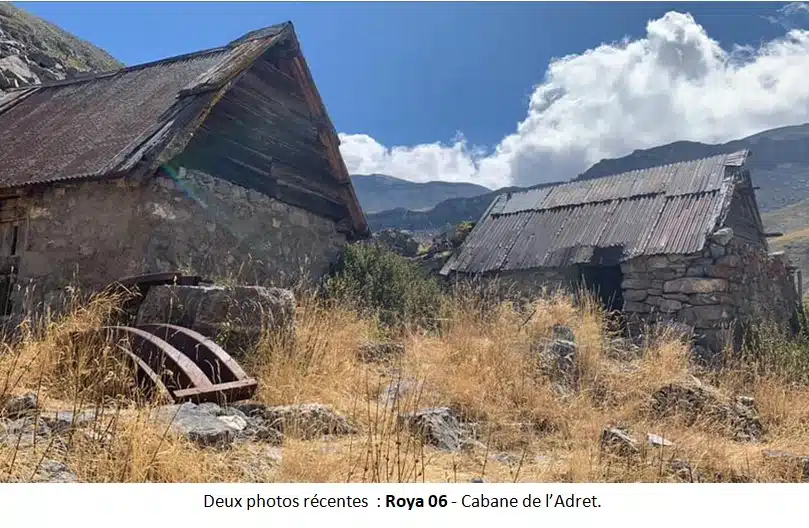
Photo Roya 06
  • The Echoes of the Week
    Storms...
    On the farm!

  • Passadoc

Storms...

Storm Ciàran first ravaged the Finisterian and Norman coasts before degrading those of the North – Pas-de-Calais...

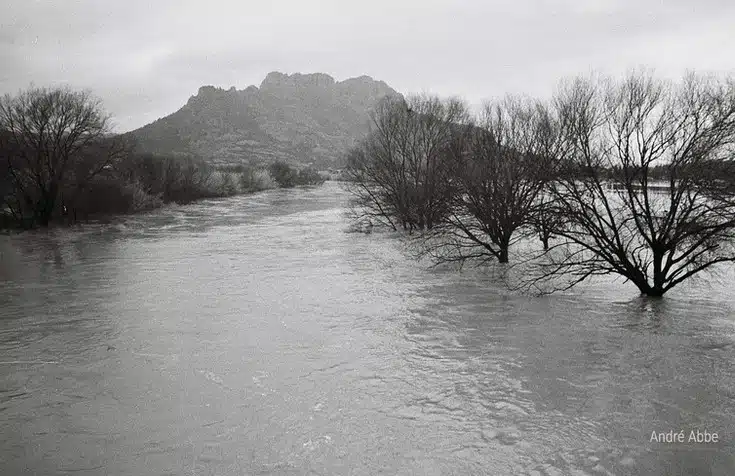
More than 40 years ago, floods devastated Occitan departments; in Roquebrune-sur-Argens in 1977. (Photo A. Abbe).
Claude Boyer
The worst was the disaster of June 2010 which caused some 30 deaths...

That said, outbursts of the Argens I knew some when I was a kid.
It flooded some cabanons in the plain where there were only crops. Since then, we have built, concreted, tarred, removed streams and even installed an industrial zone at « The Palud » !...

Malaria-malarial-moustic-marecage... Did anyone call the neighborhood name? If we add to this the shores of the Argens that are not maintained and its mouth constantly sabbed, we get as many obstacles to the good flow of water to the sea... And we shout when there's damage.

On the farm!
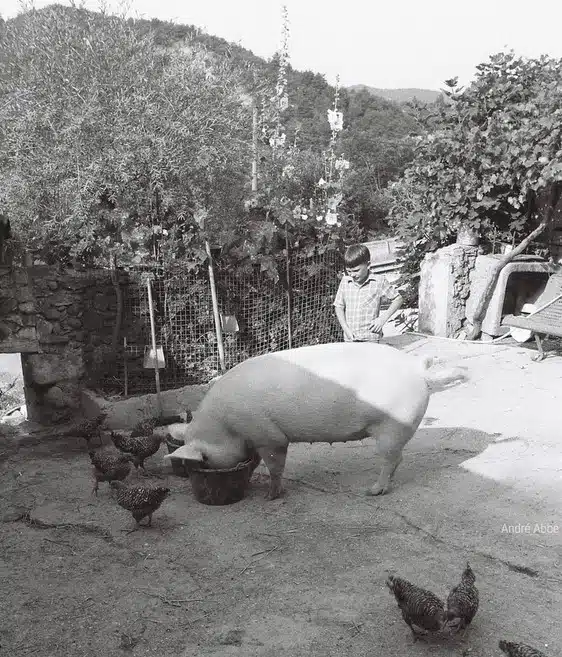
Photo A. Abbe

1984 - The Michels' farm. François is dubitative...
– Is that really what we make ham with?

Claude Boyer
 
This is Charlotte's story, the sow of the Christmas lottery... I'm talking about a time that the under 50s can't know!
 
In these remote times, during the traditional end-of-year lottos, the winners of a quine took a few grives, a pheasant, a hare or any other game.
These « lots » were suspended at the front of the Grand Café de la Place. It was in the century, what do I say in the last millennium, before our present world invents the Eurocrats and manias them to asepticate everything to make us live in a dreadful world like a soup without salt, populated with guidelines and forbidden which, among other things, make the gains in the lotto limit themselves to a microwave or vacuum cleaner.
 
Sometimes the full carton was rewarded with a live pig, or rather a piglet... it's the story I'll tell you.
 
One evening, the grocer of the village found himself very upset when he won a young sow, he lived in an apartment and could not accommodate his lot. My father at the lotto offered to house his pig because we lived in the countryside and still had a pig who had not seen pork for a long time and served as a cafoutche for tools, canesteo, plows and all the necessary equipment for any good peasant.
 
The agreements were made, my father brought the beast home: he will provide the lodging and his friend the grocer will take care of the cover with the remains of his business which, together with ours, will soon have made fatten the beast. Having agreed that once mature, it would be properly transformed into ham, sausage and chops, shared by the protagonists of the tacit contract.
 
That night, it was the party at home, my sister and I were delighted. We were going to have a sow we baptised, find out why, Charlotte. Far from doubting the fate that was waiting for her, she took possession of her neighborhoods, which were properly emptied of their heteroclite content.

The months that followed saw our host grow bigger, who was at the origin of many disputes between my sister and me to find out who was going to go to her pittance.

Then came the day when it was time for Charlotte to be slain on the altar of charcuterie.
 
Of course, we had attached ourselves to her, and it was out of the question that we should witness the killing, that we should hear the screams of her trepas. Thus, on the day of the sacrifice – before the butcher hired for the occasion arrived – to our astonishment our mother simmered us and took the bus with her to go « walk to Saint-Raphaël », something that had never happened, but at the time the children obeyed and did not ask questions.
 
When we came back all was consumed...
– A gentleman came to buy Charlotte because she had become too big and we couldn't keep her anymore.
 
Being older than my sister, I was content with the explanation doubting that this raphaëlian getaway was hiding something in connection with the disappearance of our Charlotte until the day I felt a smell of salt from « the back bedroom »My grandparents. Driven by curiosity, I took a moment of loneliness in the house to lift up the sheet under which one guessed forms and what I discovered informed me about Charlotte's fate properly drawn and salted in the rules of art.
 

I didn't say anything to my sister so I wouldn't bother her and kept my discovery on my side because I would have been scolded for going to search, something that wasn't happening.

For some time I had trouble swallowing a puck of sausage or a slice of ham, I saw Charlotte's groin pass over the door of the coconnier when we brought him his meal.

Mauricette Laborie
– It was so other time, I remember very well!!! We were happy!

Maryse Laugier
– My grandparents also had a pig and I still hear howl... I wasn't far enough away... I cried for two days; I still see him pink and nice again.
I could have become a vegetarian!

Giselle Peinat-Lorde

The story of Charlotte and the « piggy cockroach » I refer to a thousand childhood memories in the family home in Roquebrune-sur-Argens.

My grandparents always had one or two pigs, or even a small family, in the pig farm located in an annex in the garden. I did not know this glorious time nor that of one of the last tenants of the places that made resistance in the midst of German occupation ...

These heroic facts were systematically told at every big family meal... How many times have I had to hear these pagnolesque stories with my brother in the family's historical annals, both in patois and in French?

Let us return to our resistant pig: when the German troops occupied Provence, the house was quickly requisitioned by the occupant, it was therefore necessary to step in step with the co-location with the pointed helmets, after that car, horses, pigs, poultry, rabbits, fruits, vegetables, wine and everything that could be useful to the Wehrmacht were taken on board. A pig resisted retaliation because he was born disabled and was not yet an adult either.

I still imagine my grandfather, steep and straight as an I, girded with his Provençal stone and draped in his dishonored honor of a veteran, explaining to the German officer in charge of requisitions, that this brave pig was inconsumable because too young yet but especially gravely ill, dragging himself lamentably on a ham, doomed to a certain near end...

The disabled were not much appreciated by German soldiers, who most often reserved a tragic fate for them. They often feared, because of their acute sense of hygiene, also some communicable diseases, so our pig stayed in his piggy and had life saved. He continued, despite all the restrictions imposed on his atrophied leg, to suffocate and grow. Our pig, named Adolf for the circumstance by my grandfather, lived his life suspended in his piggyman and prospered waiting for better days ...

After the passage of officers of the Wehrmacht, Francophiles and francophones, who left a good memory to the family despite the circumstances, a sudden change of climate: the last roommates were SS, who threatened repeatedly to shoot the whole family – it must be said that my father and grandfather did not spare them and often played them bad tricks, at their own risk and peril – but against all expectations, they did not take care of the pig, nor too much of my grandfather's goings and comings to the garden, because they preferred to get drunk to death with everything they found.


Indeed, the wind had turned in 1944 and in August Provence was liberated. On 15 August 1944 the entire region was shaken by the bombardments provided on Antheor, which aimed to make the viaduct unusable to cut off a major supply line of the German army occupying Northern Italy. In the morning of August 15, 1944, from 6.30 a.m. to 8 a.m., intense naval artillery preparation added to a massive aerial bombardment.
 
It was stupor and trembling, especially when my grandfather went to feed Adolf, who was waiting for him, standing on his four legs, proud as Artaban ...


As soon as the Germans had folded luggage and deserted the house, to celebrate the victory, Adolf, who had found a posture worthy of a normal pig, was killed on the altar of Liberation. The ham of his atrophied leg, which had risen as if by miracle, under the effect of the bombardments on Antheor, was not eatable.

There were still some occupants of the pigman after Adolf, including a pregnant sow, Marguerite, who had run my brother throughout the garden and cellar. He was supposed to be 5/6 years old and the ban on opening the pig. But now, playing in the garden and caught by a few demons of curiosity, he pulled the anklette, the chut reel and the door opened with great scathing on a liberated Marguerite, released who rushed into the garden to indulge conscientiously in the activities of ploughing and grazing, she continued her crazy race in the cellar, massacring a few bonbons and barrels while my brother, who had taken his legs on his neck, was going to sound the alarm on the floor.
 
Marguerite, known for her placidity, good character and kindness, but quite imposing by her size, was accompanied by manu militari in the piggyman after these resounding exploits and I think my brother was called cherished that day, for the grandfather did not let anything pass. Guy certainly had to measure the 45 of the grandfather's godillots!
 
Mother and my maternal grandfather also often told me these days of celebration around the pig kill at the farm, in the Blavet neighbourhoods in Roquebrune. The owner used to have two pigs killed, one for his family and the other for the family of the farmer-metager, in this case my grandfather, before the Second World War.
 

To be issued!

François Abbe will say more soon!

  • Are cited in The Gazette :
    André Abbe
    François Abbe
    Claude Boyer
    Father Imbert
    Mauricette Laborie
    Maryse Laugier
    Jeanne Monin
    Myrmyrs de Comps
    Giselle Peinat-Lorde
    Noelie Rebuffel Huys
    Roya 06
    Valval

  • Editor in Chief
    Jeanne Monin

Passadoc