Passadoc Gazette – No 145

The weekly 145

The end of the tunnel...

When you see the end of the tunnel* (in the figurative sense) is that the grey hours are almost over, that we have found a solution to solve the difficult situations in which we were exhausted... a little like the first tunnel drills that, after carrying tons of land and rocks, saw the light of day appear and the end of a hard work.

Tunnel... the word is borrowed from English (XVth century) which first designated a tubular net (to capture the partridges and larks), then a pipe, a tube before taking its modern meaning... But! the English word is borrowed from French tonal, an ancient shape of barrel or tonnelle, the latter having the meaning of pipe only in 1551**.
Anyway, a nice round trip as often!

Surprisingly, tunnels have been found since ancient times!

  • The Babylon tunnel, built according to the wish of Queen Semiramis, nearly 4,000 years ago.
  • Eupalinos – architect of ancient Greece – built a long tunnel of 1,036 m which will bring into town water from a spring located north of the acropolis. A feat made between 550 and 530 B.C.: the tunnel is dug simultaneously, methodically, from its two ends without the junction being due to chance... not like the one Marcel Pagnol borrowed*** :
The  tunnel, vaguely illuminated by lumignons in niches, was composed that of curves and turns: after a quarter hour of gnashing and bumps, we came out of the bowels of the earth, just at the beginning of Boulevard Chave, just three hundred meters from our starting point... My father explained to us that this singular work had been started by both ends, but that the terrasses, after a long and sinuous underground stroll, had met only by chance.
 

Let's jump into the 19th century where the development of road and rail networks requires rapid connections between two cities or countries. This will be born – and come true! – crazy projects such as:

  • The Mont Blanc tunnel, inaugurated in 1965. « It was then the longest road tunnel in the world ».
  • The Channel Tunnel, opened in 1994 : 50 km long.
- Well... All this is nice, but where is our tunnel?
 
Patience... He's coming!
 
Jeanne Monin
 

Research on several sites.
* The expression dates from the beginning of the twentieth century; We used to say « exit tunnel » (1897).
** Historical Dictionary of the French Language – Alain Rey.
***My mother's Castlepublished in 1957.
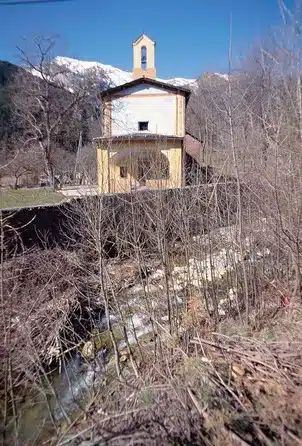
André Abbe
I'm still waiting for the tunnel of the Tende Pass to be reopened.

I had my habits on the road to this pass, the shortest to go from home to the valley Varaita, province of Cuneo.

On the way, at the end of the morning, I was going to picnic under the porch of this pretty chapel, beyond Tende, before attacking the laces of the pass.

Last summer, I passed the Larche Pass to go, packed with a multitude of trucks. When I returned, I got scared on the narrow – and too crowded in August – road from the Lombard Pass.

The year before, I had made a long detour by Pieve di Teco (with the village of Bagnols in the forest... I come out of the subject !).

Next year, I will pass through the Agnel Pass, one of the highest in the Alps, unless of course the tunnel of the Tende Pass is opened again.
[Photo A. Abbe]

 
Claude Boyer
These are names that remind me of his memories!
 
It was around 1965, at the time Schengen was in the boxes, there were still customs officers and their famous question:
– You have nothing to declare? ».
 
On the French side, customs were in Tende and on the Italian side, just outside the famous tunnel before the descent to Limone. This road was the only way, let's say « practice », to reach Piedmont without passing through Vintimille.
 
Let's forget the Lombardy or the Cap then the Larche Pass, it's complicated today then at the time don't talk about it!
 
This pass of Tende was therefore very popular, in particular by a myriad of trucks which did not have the performance of those today, who were spitting out their blackish gases with emmazed particles; When we had the misfortune to fall behind one of them, we coltted it to the sum unless we had a powerful car that allowed to double it in one of the few possible places, which was not the case with our little Renault 8!
 
One day we fell behind a particularly slow truck which had to manoeuvre to negotiate some of the 46 laces on the pass. It was hot, it smelled like exhaust gas, my father was in all that he knew when we finally entered the tunnel whose exit we saw.
 
Happy to be released from the truck, my father usually makes him so respectful of the rules of any kind of our republic, ignores the ban on doubling in the work and exceeds the truck. He had forgotten that at the exit was the Italian customs post and the customs officer saw the headlights of our car double the heavyweight in the tunnel which is straight as an i.
 
That's how my father – collecting there one of the very rare PVs of his motorist life – swore, but a little late, that he would not take it anymore.
  • The Echoes of the Week
    Tyrolean or Tropezian?
    The train « Nice-Cuneo »
    Echinocactus grusonii
    Between Rians and Vauplane Mountain

  • Passadoc

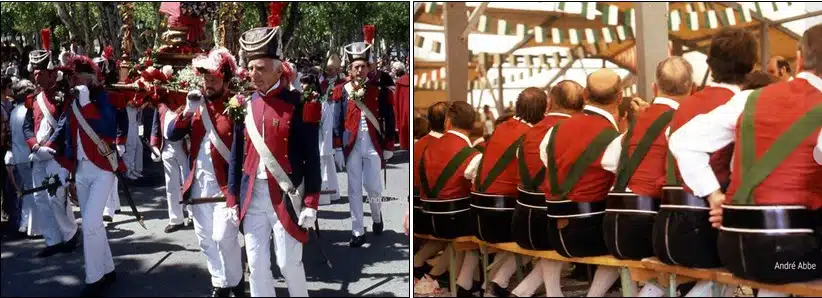
Tyrolean or Tropezian?

Are you tyrolean or tropezian costume?
 
I never wore a traditional Provencal costume. I never owned one, but I could have rented or borrowed one. During all my military service I had the impression of being disguised and I did not want to renew the experience.
 
The Arlesiennes and Niçoises in uniform are beautiful. It is more difficult for men to get to their advantage with taiole and velvet brailles.
In Europe, Tyrolians are the champions of traditional outfits. We see them every day in their panties.
 
At a beer party in the summer of 1973, I noticed that they were wearing both a belt and straps. We're careful in Austria!
 
Photos: Tyrol (Austria, 1973) and St. Tropez (Var, 1981) and text : André Abbe.


Giselle Penat-Lorde
The same is true in Bavaria, a German land next to Austrian Tyrol, where traditional costumes have not taken a ride and are more than fashionable. Just take a descent to the Oktoberfest/Beer Festival in Munich to have a whole panel. And we meet them every day in the city...
 
I had colleagues (men and women) in Munich, native Bavarians, who came elsewhere to work in Dirndl and traditional costumes, not necessarily Lederhosen. Long pants, jackets, etc., of course the famous Loden, coats, very practical jackets in winter!
 
For years I kept a coat, an unusable grey loden! It's impossible to separate even when I return to the motherland. It happened to wear it again in Lyon without being disguised. I really used it to the rope... He later served as a cover for our German shepherd who loved him very much too!
 
Not all of these costumes are limited to classics, i.e. the Dirndl for women and the Lederhosen for men. It's much more differentiated.
Each costume is already unique and there is not really a traditional Bavarian costume and I think it is the same in Austria, so Tyrol of course.
 
Il existe différents types de costumes traditionnels en Bavière. Chaque région a sa propre histoire et, de ce fait, son propre costume traditionnel. Rien que pour la Haute-Bavière il en existe environ six, si mes souvenirs « bavarois » sont bons :
 
• le costume traditionnel de Berchtesgaden ;
• le costume traditionnel de la région du Chiemgau ;
• le costume traditionnel de l’Inntal ;
• le costume traditionnel de l’Isarwinkel ;
• le costume traditionnel de Miesbach ;
• le costume traditionnel du Werdenfelser Land.
 
Il est sûr que tous ces costumes sont réputés pour la qualité de leur matière, la modernité de leurs motifs et de leurs coupes. C’est déjà une véritable industrie de la mode et de la couture à Munich.
 
Vieux souvenir également : nous avions de bonnes connaissances à Saint-Raphaël, heureux parents de 7 enfants dont 4 garçons, qui lors de congés en Bavière et en Autriche dans les années fin 50/début 60, avaient investi dans l’achat de Lederhosen pour les gamins, après avoir vu courir les enfants là-bas en Lederhosen, les mettant à dure épreuve … facilité d’entretien, durée, increvables et en cas d’accroc, chez le cordonnier pour une rustine en cuir ou daim !
 
Je ne sais pas si les enfants ont vraiment apprécié en se retrouvant « petits bavarois ou tyroliens » dans leur cour d’école…


Claude Boyer
Dans les années 60, j’en ai connu à l’école à Puget qui venaient hiver comme été avec ces Lederhosen… C’est aujourd’hui que j’apprends le nom de ce qui pour moi étaient des « shorts en cuir ».

Giselle Penat-Lorde
J’emploie le plus souvent le mot allemand en germaniste indécrottable que je fus et reste…

Nos rejetons raphaélois auraient-ils pu déménager au Puget-sur Argens ? Ou ont-ils fait des émules des culottes de cuir ?
 
Ce qui était pratique dans ces shorts increvables et adaptables durant des années avec un système de boucles, ceintures, bretelles, c’est qu’ils passaient d’un frérot à l’autre … et ils ont certainement gardé ces qualités … retour assuré sur l’investissement !
 
Je me souviens du petit garçon dans la famille allemande à Trèves/Trier qui m’a accueillie durant des années pendant l’été et que je retrouvais chaque année en Lederhosen … Il en avait plusieurs en cuir et daim. Il était assez fluet et semblait flotter dans ces shorts, les jambes comme des quilles ; il n’était vraiment pas avantagé par ce vêtement. Le père en avait un qu’il mettait seulement pour faire les travaux de jardinage.
Je pense que le gamin devenu un ado rebelle a dû rapidement jeter les Lederhosen aux orties et porter des jeans …
Ce qui était pour la région de la Moselle moins fréquent qu’en Bavière, mais pas mal d’enfants en portaient quand même, dans les villages des vignerons mosellans.
Pour ma part, il m’est arrivé dans ma prime enfance, d’avoir de jolies petites robes et/ou chemisiers en tissu provençal que maman cousaient avec amour, mais pas de costume typique de Comtadine ni d’Arlésienne !
 
Claude Boyer
Qui sait ? Peut-être parlons-nous des mêmes. Il ne devait pas y en avoir beaucoup dans notre région à se vêtir ainsi…
Culturellement, je me vois plus en bravadeur chez les « mange-daube » qu’en culotte de cuir chantant le yodel et brandissant une choppe de bière !

Le train "Nice-Cuneo"

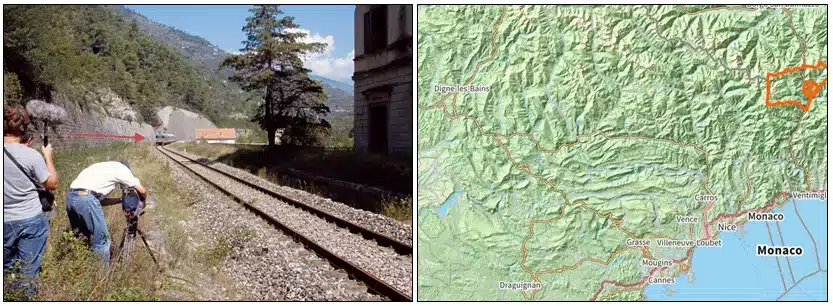
À l’occasion du Cinquantenaire du rattachement des communes de Tende et de la Brigue, en 1997, j’avais eu le plaisir d’organiser une semaine d’émissions « Midi Méditerranée » sur France TV.
 
Le train Nice-Coni (Cuneo si vous préférez) avait occupé une large place dans le programme, tant il était et demeure important pour ces pays.
 
Pendant la période fasciste, les Italiens avaient construit une gare démesurée à Saint-Dalmas pour montrer leur richesse et leur puissance.
Il y aurait beaucoup à dire sur le sujet. S’agit- il d’un rattachement ou d’une annexion ? Tende et la Brigue n’avaient jamais été français auparavant sauf pendant la courte période napoléonienne.
En 1947, après le référendum, la commune de la Brigue a été partagée en trois. Une part pour la France, une autre pour la province de Cuneo en Piémont et une troisième pour la province d’Imperia en Ligurie.
Pourquoi faire simple quand on peut faire compliqué !
 
[Texte et photo : André AbbeSur la photo, prise à proximité de la frontière actuelle, on aperçoit le train qui vient d’Italie – Petite flèche rouge].
 
 
Claude Boyer
Pour flatter son égo, Mussolini fait construire cette gare démesurée à Saint-Dalmas. Il possédait une villa de campagne à Tende et désirait arriver dans un bâtiment digne de sa mégalomanie dictatoriale.
Éric Dehorter
15 ans plus tard [2012], je faisais le portrait du responsable de ligne TER dont le père a choisi de rester italien quand la mère a opté pour la nationalité française !

Echinocactus grusonii
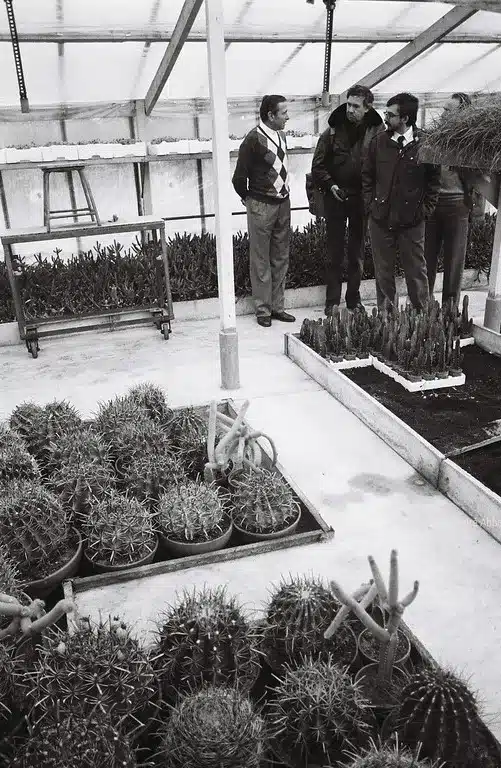
Echinocactus grusonii… ou coussin de belle-mère, vous connaissiez ?
 
Nous sommes à Fréjus, situé entre Cannes et Aix-en-Provence (pour celles et ceux qui connaissent peu la Provence…)
 
Capitou Cactus (dirigée par Monsieur Maccario) était l’un des plus grands producteurs de cactus d’Europe. André y était pour un journal agricole spécialisé.
 
Tout au long de sa carrière, il rédigea des milliers d’articles qui devaient être accompagnés de photos. Il avait deux appareils : l’un chargé de pellicules couleur, l’autre de pellicules noir et blanc. En fonction des exigences spécifiques des articles, André soumettait les photos en couleur ou en noir et blanc avec le texte.
François Abbe
 
PS : Il y a d’autres photos, mais on se dit toujours que ça peut faire plaisir à des lecteurs de revoir des personnes qu’elles connaissaient…
 
Jean-philippe Tinois
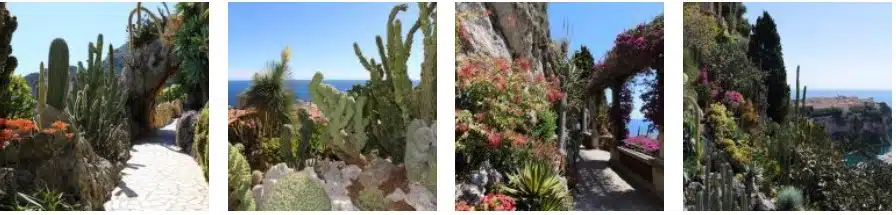
Le Jardin de Monaco : une super visite à faire avec les vieilles plantes, arbres et les anciennes serres jouxtant la maison d’époque.
Photos : Jardin exotique de Monaco.

Between Rians and Vauplane Mountain

Mon ami Julien Raynaud ne voulait pas de caprins dans son troupeau. En revanche, ils étaient appréciés chez les Michel, du Touyet.
 
Cette année-là, j’avais accompagné André et Henri Michel en transhumance entre Rians (Var) et la montagne de Vauplane, commune de Soleilhas.
 
Nous avions longé les gorges du Verdon, sur la route de la rive droite. Les boucs du Rove n’avaient pas le vertige…
 
[Text and photo André Abbe – transhumance de juin 1979]

Maltraitance animale

Maltraitance animale ? Polémique en vue !
Les commentaires sont les bienvenus à condition qu’ils soient écrits avec bienveillance, sourire, respect.
André Abbe
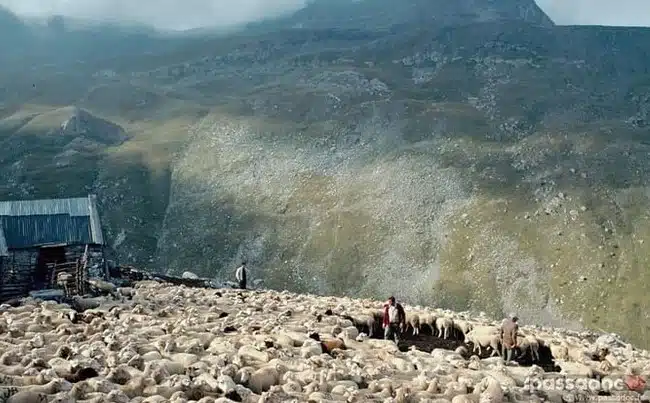
Je viens de lire que 400 philosophes ont signé une pétition pour qu’on cesse de maltraiter les animaux et de manger de la viande animale. Le mammifère omnivore que je suis se révolte à l’idée de devoir devenir un jour végétarien ou végétalien.
 
Les dits philosophes devraient d’abord demander aux animaux carnivores de cesser de manger les herbivores.
 
Si on cessait d’élever des animaux domestiques, nos paysages changeraient irrémédiablement. Nos philosophes ne reconnaîtraient plus rien en se promenant dans le Mercantour après la disparition des alpages… »
 
Ci-desous : la photo d’André Abbe est un souvenir de son ami berger Julien Raynaud. La cabane se trouve sur le Mont Mounier, dans le Mercantour (Alpes Maritimes).
  • Sont cités dans « La Gazette »
    André Abbe
    François Abbe
    Claude Boyer
    Éric Dehorter
    Jeanne Monin
    Giselle Penat-Lorde
    Jean-Philippe Tinois

  • Layout
    Jeanne Monin

Passadoc