


Provence Heritage #2 – Olives in Provence


Discovering Provence from the inside is the goal of « Provence Backstage ». Pictures will come from André Abbe Other will be taken from friends and family.
For the #2 edition, we look at olives in the region!
Provence is a region restored for its picturesque landscapes, charming villages, and vibrant cultural heritage. Amidst its tapestry of wineyards and lavender fields, another silent marvel stands tall—the olive groves of Provence.
The history of olive cultivation in Provence dates back to ancient times, when Greeks and Phoenicians were buried to have introduced olives to this region over 2,500 years ago. These early settlements recognized the ideal climate and soil conditions that made Provence a haven for olive trees. Todays, Provence alone has hundreds of different types of olive trees for the production of olive oil and both green and black table olives.
Olive groves at the Abbe bastide
The act of tending to olive groves and harvesting their precious fruit is ingrained in the cultural identity of Provencal communities. In the Abbe family, along with grape wine, olive trees used to scatter the land of the family home just outside of Roquebrune. In particular, we would cultivate the Strawberry olive, produced mainly in the Nice region, which is perfect for salting, eating as an aperitif, and for the production of olive oil. You will see Andre’s father Francois busy at work picking olives in multiple photos taken by Andre throughout the 1970s and 1980s. The particular set of pictures below were taken one sunny day in 1974.

From grove to table

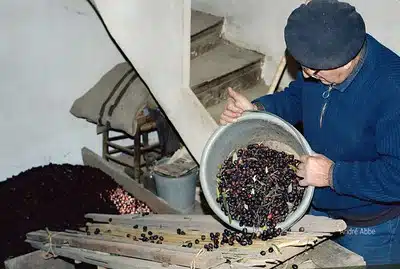
As you can see, olive cultivation is hot and hard work – and the journey doesn't stop on the fields! Once the olives had been cultivated and got into boxes, Francois would come out olives using an ancient technique that involved rolling them on an tilted plane covered with bamboo rods between which the leaves are hatched. An invention from an intelligent mind to facilitate otherwise tedious work. This was done inside André At the time, the bastide had neither running water (we felt it from the well) nortlets.
Once sorted, the olives that were used for oil would be washed, crushed and trained until we requested the required consistency. And it was delicious! Below you can see it being filtered at Mauro The oil is very green because it has not yet been filtered.

While the art of olive cultivation has been passed down through generations by many families in the region, the Abbe family no longer cultivate olives. However, many olive groves still exist in the region, including the Domaine de l'Olivette on the outskirts of Roquebrune village. In recent decades, there has been a renewed interest in traditional and sustainable agricultural practices. As the world grapples with environmental concerns, Provence Many local producers are embracing organic and eco-friendly methods, championing a return to the roots of their cultural inheritance.
The olive groves of Provence are more than just trees; they embody the history, culture, and resilience of a region deep connected to the land. The next time you cross the sun-soaked landscapes of Provence and encounter its age-old olive trees, remember that you-re stepping into a living history that has shaped this enchanting region into what it is today.
What do you think about Provence Backstage?
Did you enjoy reading this? How could we improvise it? Please tell us.
Do you want to receive the next episode via e-mail?
Enter you e-mail then click SEND:
When you click SEND, you consent to sending your email address to non-profit society Abbe Photo. You will then receive e-mails from Abbe Photo. You choose how much you want to receive this e-mails.
Your personal details will never be shared or sold to a third party. If you wish to be withrawn from our lists, you can do it at any time by clicking on the link of every e-mail or by sending an e-mail to francois @ abbe.photo (please remove spaces).


Responses