


The Revolutionary and the Micocolier

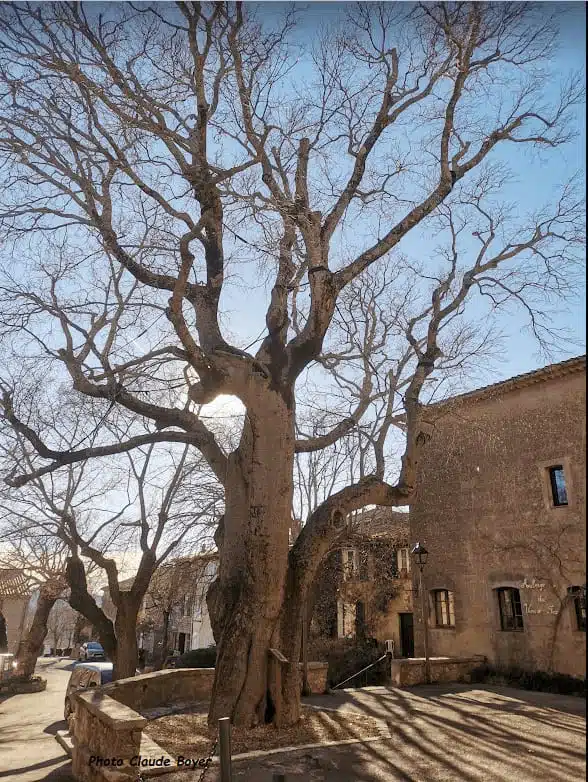
At the gates of the Verdon between Sillans la Cascade and Montmeyan, you can reach the village of Fox-Amphoux perched at 540 meters above sea level by a road in the ass of a bag.

An unusual name
Fox-Amphoux, what a strange name will you tell me. The castrum of Fors was quoted in 1097, while the castrum of Amfos appeared in 1233. Fors-Amfos became Fox-Amphoux in 1471. In addition to this unusual name, Fox-Amphoux also stands out as the village where one can admire a five-year-old micocolorier who owes Paul Barras not to have been shot. But what is the relationship between the revolutionary and this majestic tree that has been standing for half a millennium in front of the village church?
Here's the story

In the village there is probably the oldest micocolier in the whole country, its trunk is more than five meters in circumference; He is given the venerable age of 470 years. It was planted in 1550, after the death of François Premier. It should be noted that under the old regime it was customary to plant a micocolorier in front of the churches because he had the reputation of being a « casa diaule » (Shit chase). Arrived the French Revolution and the Micocolers were shot down as they were associated with religion as protectors of the churches. Fox Amphoux's should survive the "citizen" Barras who prevented his slaughter.


A Prestigious Fox
Famous figure of the Revolution, Paul Barras was born in Fox on 30 June 1755. With Tallien and Fouché, he was at the origin of the fall of Robespierre and greatly favoured the ascent of Napoleon Bonaparte. He died in Paris on January 29, 1829 and rested in the cemetery of Father Lachaise.
A tree with multiple uses

The micocollier is renowned in carpentry for the quality of its wood. In Sorède, in the Pyrénées Orientales, there remains a workshop which still works the micocolier as it was done in the 13th century to make ties, while in Sauve in the Gard one manufactures forks with its branches. Its fruit, the micocole is edible: yellow or burgundy in colour, it is fleshy and has a crunchy core rich in fat that are good fatty acids; as for the pulp, it has a caramelized apple taste. Alcohol can also be flavoured; oil from its nuclei is used in cosmetics and medicinal ointments. In spring it is possible to consume its floral buds and leaves, rêche to the touch, similar to those of the nettle.
Paul Barras' birth certificate
I looked for Paul Barras' birth certificate

The year one thousand seven hundred and fifty-five and the thirtieth day of the month of June was born noble Jean Nicolas Paul François de Barras, son of noble François and of lady Elisabeth Pourcelly his wife, and was baptized on the next four July the godfather Messire Jean Nicolas de Raphaelis of Agout knight Marquis de Rognes the godmother Mademoiselle Louise Françoise Gabrielle of Albert du Chaine marquise of this place all signed


Responses